6-Stage vs 3-Stage Reverse Osmosis Systems: Which Should You Buy?
As an Amazon Associate we earn from qualifying purchases. Links on this page are affiliate links.
Choosing a 6-Stage vs 3-Stage reverse osmosis system depends on your filtration needs and space constraints. Both options install under your sink and use multi-stage processes to improve water quality. The main difference lies in the number of filtration stages and the resulting water output. Product A offers a traditional RO approach with remineralization, while Product B uses a different filtration technology for faster flow. You need to decide which balance of purity and speed fits your kitchen best.
Key differences
| Aspect | iSpring RCC7AK-BN 75 GPD Alkaline RO | Aquasana AQ-6300-BN 3-Stage Under Sink |
|---|---|---|
| Filtration Stages | 6-Stage | 3-Stage |
| Capacity | 75 GPD | 0.5 gallons per minute |
| Certification | NSF 58 | NSF 42, 53 & 401 |
| TDS Reduction | Reduces TDS (93-98%) | Will NOT reduce TDS |
| Remineralization | Alkaline Filter, Remineralization | Retains minerals |
Which one should you choose?
Choose iSpring RCC7AK-BN 75 GPD Alkaline RO if
- You want to reduce Total Dissolved Solids (TDS) and remove fluoride.
- You prefer a system certified specifically for reverse osmosis performance.
- You value the ability to add essential minerals back into purified water.
Choose Aquasana AQ-6300-BN 3-Stage Under Sink if
- You need faster water flow for cooking and filling bottles.
- You want to retain natural minerals while removing contaminants.
- You prefer a compact unit with simpler filter replacement.
Verdict: Choose the iSpring RCC7AK-BN if you prioritize deep contaminant removal and TDS reduction through a certified reverse osmosis process. Select the Aquasana AQ-6300-BN if you value high flow rates and mineral retention without the wait time of traditional RO systems.
6-Stage vs 3-Stage RO Systems
filtration stages
The iSpring RCC7AK-BN uses a 6-Stage Reverse Osmosis process with an added alkaline filter. This multi-stage setup targets a broad spectrum of contaminants, including lead, fluoride, and PFAS, while also remineralizing the water to improve taste and pH. In contrast, the Aquasana AQ-6300-BN relies on a 3-Stage Claryum filtration system. It focuses on reducing specific contaminants like chloramines and microplastics but explicitly does not reduce Total Dissolved Solids (TDS). If you want comprehensive contaminant removal and mineral adjustment, the iSpring approach is more thorough. If you prefer retaining natural minerals without lowering TDS, the Aquasana method suits you better.
certification
Certifications verify that a system meets independent safety and performance standards. The iSpring RCC7AK-BN holds NSF/ANSI 58 certification for the entire reverse osmosis system. This standard specifically covers the removal of contaminants through membrane filtration. The Aquasana AQ-6300-BN is WQA certified to NSF 42, 53, and 401. These standards address aesthetic effects like taste and odor, as well as health effects including lead and pharmaceuticals. While iSpring’s certification is tailored to RO performance, Aquasana’s multi-standard coverage highlights its strength in chemical and pharmaceutical reduction. Both offer strong third-party validation, but they verify different aspects of water quality.
capacity
Water output speed matters for daily tasks like cooking and filling pitchers. The iSpring RCC7AK-BN produces 75 gallons per day (GPD). This is a standard capacity for residential RO systems, though it typically requires a storage tank to build up volume. The Aquasana AQ-6300-BN delivers water at a flow rate of 0.5 gallons per minute. This is significantly faster than traditional drip-style RO systems and much quicker than pitcher filters. You get immediate filtered water without waiting for a tank to fill. If you need high-volume water quickly for multiple uses, the Aquasana flow rate offers a practical advantage over the slower daily production rate of the iSpring unit.
design
Physical dimensions affect how well a system fits under your sink. The iSpring RCC7AK-BN is a larger unit, measuring 18.5 inches in height, 14.5 inches in length, and 5.25 inches in width. It weighs 27.6 pounds, which is typical for RO systems with tanks. The Aquasana AQ-6300-BN is more compact, standing 9 inches tall, 12 inches long, and 4.25 inches wide. It lacks a heavy storage tank, making it lighter and easier to maneuver. If you have limited under-sink space or want a sleeker profile, the Aquasana design is more space-efficient. The iSpring requires more room to accommodate its full filtration and storage setup.
features
Each system includes unique features to enhance user experience. The iSpring RCC7AK-BN offers a transparent first-stage filter housing, allowing you to visually monitor contaminant buildup. It also features a patented top-mounted fastener for easier installation from above the sink. The Aquasana AQ-6300-BN includes a complete installation kit with a dedicated faucet and parts. It is designed for simple twist-off filter replacement. While iSpring focuses on monitoring and easy mechanical access, Aquasana emphasizes convenience and speed. Both designs aim to simplify maintenance, but they achieve this through different mechanical approaches.
Choose Your Best RO System
You want pure water with balanced pH
The iSpring RCC7AK-BN uses a 6-Stage Reverse Osmosis process with an alkaline filter to remineralize water. It reduces TDS by 93-98% and removes PFAS, lead, and fluoride. This system delivers spring-like water with a healthy pH, making it ideal for those prioritizing comprehensive contaminant removal and improved taste.
You need fast flow for daily cooking
The Aquasana AQ-6300-BN delivers water at 0.5 gallons per minute, which is five times faster than pitcher filters. Its 3-Stage Claryum filtration reduces 78 contaminants, including chloramines and microplastics, while retaining minerals. This high-flow output is perfect for quick hydration and cooking without waiting for tank refills.
You have limited under-sink space
The Aquasana system measures 12 inches in length and 9 inches in height, fitting easily into tight cabinets. It requires only 12 inches of clearance for installation. In contrast, the iSpring unit is significantly larger at 18.5 inches tall and 14.5 inches long, requiring more room under your sink.
Quick picks
| # | Product | Best for | Price |
|---|---|---|---|
| 1 | iSpring RCC7AK-BN 75 GPD Alkaline RO | Certified contaminant reduction with mineral balance | Check price of iSpring RCC7AK-BN 75 GPD Alkaline RO on Amazon |
| 2 | Aquasana AQ-6300-BN 3-Stage Under Sink | Fast-flow mineral-retaining filtration | Check price of Aquasana AQ-6300-BN 3-Stage Under Sink on Amazon |
The products compared

iSpring RCC7AK-BN 75 GPD Alkaline RO
Best for: Certified contaminant reduction with mineral balance
- Filtration Stages
- 6-Stage (what this guide is about)
- Capacity (GPD)
- 75 GPD
- Certification
- NSF 58
- Filtration Type
- Reverse Osmosis, Alkaline
- Installation Type
- Under Sink
- Features
- Alkaline Filter, Remineralization
View on Amazon: iSpring RCC7AK-BN 75 GPD Alkaline RO Affiliate link
This iSpring system uses a 6-stage reverse osmosis process with an alkaline remineralization filter. It produces 75 gallons per day and holds NSF 58 certification for the entire unit. The transparent first-stage housing lets you monitor filter buildup. You get a balanced pH and added minerals. The design allows for countertop installation from above. It reduces over 1,000 contaminants including lead and PFAS.
Pros
- NSF 58 certified for the full system
- 6-stage filtration with alkaline remineralization
- Transparent first-stage housing for monitoring
- Top-mounted fastener for easy installation
- Reduces TDS by 93-98%
Cons
- 75 GPD capacity is lower than high-output models
- Standard size may not fit very small cabinets
- No smart app or remote control mentioned
Good fit if
- You want NSF certified whole-system protection
- You prefer water with added minerals
- You need easy countertop installation access
Skip if
- You need more than 75 gallons daily
- You require smart home connectivity
- You want a 3-stage simple setup
Verdict: iSpring RCC7AK-BN 75 GPD Alkaline RO is a solid choice for households prioritizing certified contaminant reduction and mineral balance. It suits those who value transparent filter monitoring and straightforward under-sink installation over high-volume output.
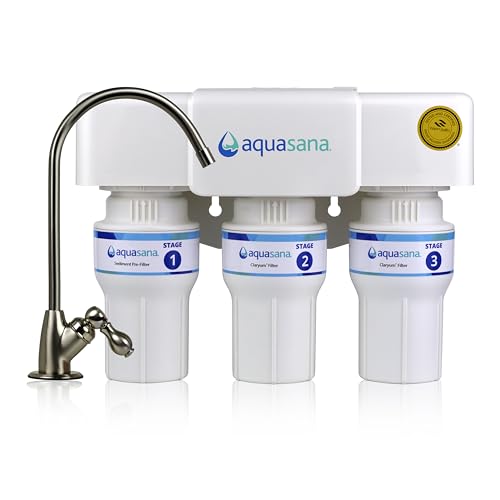
Aquasana AQ-6300-BN 3-Stage Under Sink
Best for: Fast-flow mineral-retaining filtration
- Filtration Stages
- 3-Stage (what this guide is about)
- Design
- Under sink
- Certification
- WQA, NSF 42, 53 & 401
- Contaminants Removed
- Lead, PFAS, microplastics, chloramines
- Installation Type
- Under sink
- Features
- Chlorine Reduction
View on Amazon: Aquasana AQ-6300-BN 3-Stage Under Sink Affiliate link
This Aquasana system uses Claryum 3-stage filtration to reduce 78 contaminants, including lead and PFAS, while retaining beneficial minerals. It does not reduce TDS. You get a high-flow output of 0.5 gallons per minute, which is significantly faster than pitcher filters. The unit is NSF 42, 53, and 401 certified. It fits under your sink in 12 inches of space and includes a brushed nickel faucet.
Pros
- NSF 42, 53 & 401 certified for contaminant reduction
- High-flow rate of 0.5 gallons per minute
- Retains healthy minerals while filtering
- Includes faucet and installation kit
Cons
- Does not reduce Total Dissolved Solids (TDS)
- 3-stage filtration has fewer stages than 6-stage RO systems
- Requires 12 inches of under-sink clearance
Good fit if
- You want fast-flowing filtered water for cooking
- You prefer to retain minerals in your water
- You need NSF certification for specific contaminants
Skip if
- You require reverse osmosis to remove TDS
- You need a 6-stage filtration system
- You have less than 12 inches of under-sink space
Verdict: Aquasana AQ-6300-BN 3-Stage Under Sink Filter is a practical choice for those prioritizing speed and mineral retention over TDS reduction. It suits users who want certified contaminant removal without the slow drip of traditional RO systems.
Specifications side by side
| Spec | iSpring RCC7AK-BN 75 GPD Alkaline RO | Aquasana AQ-6300-BN 3-Stage Under Sink |
|---|---|---|
| Filtration Stages | 6-Stage | 3-Stage |
| Capacity (GPD) | 75 GPD | not stated |
| Design | not stated | Under sink |
| Certification | NSF 58 | WQA, NSF 42, 53 & 401 |
| Filtration Type | Reverse Osmosis, Alkaline | not stated |
| Contaminants Removed | not stated | Lead, PFAS, microplastics, chloramines |
| Installation Type | not stated | Under sink |
| Capacity | 75 GPD | not stated |
| Features | Alkaline Filter, Remineralization | Chlorine Reduction |
| Color | Brushed Nickel Faucet | Brushed Nickel |
| Dimensions | 14.5 × 5.25 × 18.5 inches | 12 × 4.25 × 9 inches |
| Weight | 27.6 pounds | not stated |
| Size | Standard | 3-Stage |
| Model | RCC7AK-BN | AQ-6300-BN |
Frequently asked questions
What is the main difference between a 6-stage and 3-stage RO system?
The primary difference is the number of filtration stages and the resulting water quality. A 6-stage system, like the iSpring RCC7AK-BN, uses multiple filters to remove more contaminants and adds an alkaline filter for remineralization. A 3-stage system, such as the Aquasana AQ-6300-BN, focuses on faster flow and mineral retention rather than deep purification.
Does a 6-stage reverse osmosis system remove more contaminants than a 3-stage one?
Yes, a 6-stage system typically removes a broader spectrum of contaminants. The iSpring RCC7AK-BN reduces TDS by 93-98% and targets specific pollutants like lead, fluoride, and PFAS. In contrast, a 3-stage system like the Aquasana AQ-6300-BN prioritizes speed and mineral retention, offering certified removal but with less aggressive TDS reduction.
Which system provides better tasting water with balanced pH?
The 6-stage iSpring RCC7AK-BN is designed for balanced pH and enhanced taste. It includes an alkaline filter that remineralizes water, improving flavor and neutralizing acidity. The 3-stage Aquasana AQ-6300-BN retains minerals for a natural taste but does not actively adjust pH levels through a dedicated remineralization stage.
Are 3-stage RO systems faster than 6-stage systems?
Generally, yes. The Aquasana AQ-6300-BN is noted for its fast-flow mineral-retaining filtration, avoiding the slow drip common in traditional RO setups. While the iSpring RCC7AK-BN offers certified contaminant reduction, its 75 GPD capacity and multi-stage process may result in slower output compared to the streamlined 3-stage design.
Do I need NSF certification for my reverse osmosis system?
NSF certification ensures the system meets specific safety and performance standards for contaminant reduction. Both the iSpring RCC7AK-BN and the Aquasana AQ-6300-BN carry this certification. This means you can trust the listed contaminant reduction claims, whether you choose the deep purification of a 6-stage system or the fast flow of a 3-stage model.
Which system is better for small under-sink spaces?
The 3-stage Aquasana AQ-6300-BN is more compact, measuring 12 inches in length and 9 inches in height. The 6-stage iSpring RCC7AK-BN is larger, with a length of 14.5 inches and a height of 18.5 inches. If space is limited, the smaller 3-stage unit may fit more easily under your sink.
Can a 3-stage system remove PFAS and lead?
The Aquasana AQ-6300-BN is certified for contaminant removal, but its 3-stage process focuses on speed and mineral retention. The 6-stage iSpring RCC7AK-BN explicitly targets PFAS and lead through its multi-stage filtration and remineralization process. If removing these specific contaminants is a priority, the 6-stage system offers more comprehensive protection.