Aquasana or GE? Reverse Osmosis Systems Compared in 2026
As an Amazon Associate we earn from qualifying purchases. Links on this page are affiliate links.
This aquasana vs GE reverse osmosis system comparison looks at two under-sink units. Both fit under your counter and use three filtration stages. The main difference is the technology. Aquasana uses Claryum media to remove contaminants while keeping minerals. GE uses reverse osmosis to strip impurities, including minerals, for highly purified water. You choose based on whether you prefer mineral retention or maximum purity.
Key differences
| Aspect | Aquasana AQ-6300-BN 3-Stage Under Sink | GE GXRQ18NBN 3-Stage Under Sink RO |
|---|---|---|
| Filtration Type | Claryum 3-Stage | Reverse osmosis |
| Certification | NSF 42, 53 & 401 | Not listed |
| Flow Rate | 0.5 gallons per minute | Not listed |
| Color | Brushed Nickel | White |
| Filter Indicator | Not listed | Yes |
Which one should you choose?
Choose Aquasana AQ-6300-BN 3-Stage Under Sink if
- You want filtered water with minerals retained
- You need NSF 401 certification for pharmaceuticals
- You prefer a faster flow rate for filling bottles
Choose GE GXRQ18NBN 3-Stage Under Sink RO if
- You want maximum contaminant removal via reverse osmosis
- You value a visible filter change indicator
- You prefer a white finish for your faucet
Verdict: Choose Aquasana if you want fast, mineral-rich water with certified broad-spectrum filtration. Choose GE if you prioritize the deep purification of reverse osmosis and want a visual cue for filter changes. Your decision rests on whether you value speed and minerals or maximum purity.
Aquasana vs GE RO Specs
Filtration Technology
Aquasana uses Claryum 3-Stage filtration, which removes contaminants while retaining beneficial minerals in your water. It does not reduce Total Dissolved Solids (TDS). GE uses reverse osmosis technology. This process strips impurities from the water. You can add a remineralization filter to restore minerals if you prefer. The core difference is mineral retention versus total purification. Aquasana keeps minerals naturally. GE removes them first, then optionally adds them back. Your choice depends on whether you want to keep minerals by default or remove everything first.
Certification Standards
Aquasana is WQA certified to NSF 42, 53, and 401 standards. This covers aesthetic effects, health contaminants, and emerging compounds like pharmaceuticals. The data lists these specific certifications. GE lists that it reduces 95 impurities, including lead, chlorine, and arsenic. It does not list specific NSF certification numbers in the provided data. Aquasana provides full lab data online for verification. GE relies on general impurity reduction claims. If you need verified third-party certification for specific contaminant classes, Aquasana provides clearer documentation of its standards.
Flow Rate
Aquasana delivers filtered water at 0.5 gallons per minute. This is five times faster than leading pitcher filters. It fills bottles and cooking pots quickly. GE does not list a specific flow rate in the provided data. Reverse osmosis systems typically have slower flow rates than non-RO filters due to the membrane process. Without a specific number for GE, you cannot compare speed directly. Aquasana’s high-flow output is a clear advantage for daily tasks like cooking. You will not wait as long for filtered water with the Aquasana unit compared to typical RO systems.
Filter Replacement
Aquasana filters last up to 6 months or 600 gallons. You twist off the housing to replace them. GE uses a twist/lock design for easy changes with zero mess. It requires specific replacement filters, FQ18PN and FQ18MN. Aquasana does not list the lifespan of GE filters. GE does not list gallons per minute or total gallon capacity for its filter life. Aquasana provides a clear replacement timeline. GE provides a clear mechanical replacement method. Both systems are designed for user-friendly maintenance. Aquasana gives you a time-based limit. GE gives you a visual indicator on the faucet.
Physical Dimensions
Aquasana measures 12 inches long, 4.25 inches wide, and 9 inches high. GE measures 12.5 inches long, 3.63 inches wide, and 9.25 inches high. GE weighs 14.1 pounds. Aquasana does not list weight. Both units are designed for under-sink installation. GE is slightly wider in length but narrower in width. Aquasana is taller in width but shorter in height. The space requirements are similar. Both need clearance under the sink. GE includes push-to-connect fittings for installation. Aquasana includes a complete installation kit. Both fit standard under-counter spaces.
Choose the Right System for You
You want fast flow and mineral retention
The Aquasana AQ-6300-BN delivers 0.5 gallons per minute, which is five times faster than standard pitcher filters. Its Claryum 3-Stage filtration reduces up to 99.99% of 78 contaminants, including lead and PFAS, while retaining beneficial minerals. It will not reduce TDS levels. This system is WQA certified to NSF standards 42, 53, and 401 for reliable performance.
You need deep impurity removal with RO
The GE GXRQ18NBN uses reverse osmosis technology to strip impurities from your water. It reduces 95 impurities, including lead, chlorine, and arsenic. This system offers a triple-stage filtration process designed for thorough contaminant removal. It includes a filter change indicator on the faucet to alert you when maintenance is needed, ensuring consistent water quality over time.
You prefer easy DIY installation with twist filters
Aquasana includes a complete installation kit for under-sink DIY setup, requiring only 12 inches of space. Filter replacement is simple; you just twist off the housing to swap the unit. Each filter lasts up to 6 months or 600 gallons. This design helps prevent bacterial buildup and media saturation while providing a straightforward maintenance routine for your kitchen.
The products compared
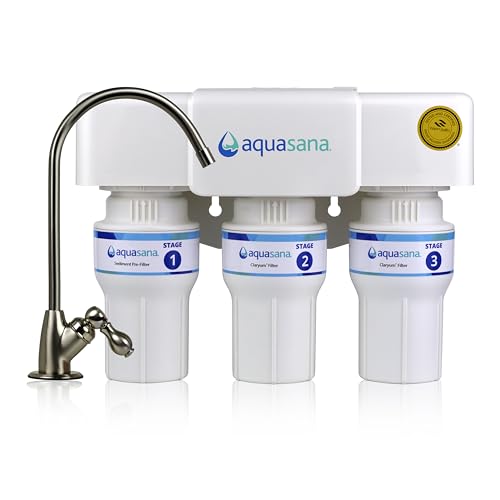
Aquasana AQ-6300-BN 3-Stage Under Sink
Best for: Removing specific contaminants without reducing TDS
- Filtration Stages
- 3-Stage
- Design
- Under sink
- Certification
- WQA, NSF 42, 53 & 401
- Contaminants Removed
- Lead, PFAS, microplastics, chloramines
- Installation Type
- Under sink
- Features
- Chlorine Reduction
View on Amazon: Aquasana AQ-6300-BN 3-Stage Under Sink Affiliate link
The Aquasana AQ-6300-BN is a 3-stage under sink water filter using Claryum technology. It is WQA certified to NSF 42, 53, and 401 standards. The system reduces up to 99.99% of 78 contaminants, including lead and PFAS. It delivers filtered water at 0.5 gallons per minute. This model retains beneficial minerals and does not reduce TDS. It fits under sinks with 12 inches of space.
Pros
- WQA certified to NSF 42, 53, and 401 standards
- Reduces up to 99.99% of 78 contaminants including lead and PFAS
- Fast flow rate of 0.5 gallons per minute
- Retains minerals and does not reduce TDS
Cons
- Does not reduce total dissolved solids (TDS)
- Limited to 600 gallons or 6 months filter life
- Requires 12 inches of under-sink clearance
Good fit if
- You want to remove lead and PFAS without reducing TDS
- You need a faster flow rate than pitcher filters
- You prefer a 3-stage Claryum filtration system
Skip if
- You require reverse osmosis membrane filtration
- You need to reduce total dissolved solids
- You have less than 12 inches of under-sink space
Verdict: Aquasana AQ-6300-BN 3-Stage Under Sink Filter is ideal for users seeking certified contaminant removal while retaining minerals. It suits those who prioritize flow speed and specific NSF certifications over TDS reduction.

GE GXRQ18NBN 3-Stage Under Sink RO
Best for: compact under-sink lead and arsenic reduction
- Filtration Stages
- 3
- Design
- Under sink
- Filtration Type
- Reverse osmosis
- Contaminants Removed
- Lead, chlorine, arsenic, 95 impurities
- Features
- Chlorine Reduction
- Color
- White
View on Amazon: GE GXRQ18NBN 3-Stage Under Sink RO Affiliate link
This GE under-sink system uses a three-stage reverse osmosis process to reduce lead, chlorine, arsenic, and up to 95 impurities. It includes a dedicated faucet with an integrated filter change indicator and installs with push-to-connect fittings. Measuring 12.5 by 3.63 by 9.25 inches, this compact unit fits households wanting verified contaminant reduction in tight cabinet spaces.
Pros
- Reduces lead, chlorine, arsenic, and 95 total impurities
- Dedicated faucet includes an integrated filter change indicator
- Twist-and-lock filter housing enables mess-free cartridge changes
- Push-to-connect fittings simplify under-sink plumbing connections
Cons
- Remineralization filter is not included and must be purchased separately
- Limited to three filtration stages
Good fit if
- You need a reverse osmosis system that fits a slim 3.63-inch cabinet width profile.
- You want a dedicated faucet that tracks filter lifespan automatically.
- You prefer push-to-connect fittings and twist-and-lock filter replacements.
Skip if
- You want remineralized alkaline water directly out of the base package.
- You require a four-stage or five-stage filtration system.
Verdict: GE 3-Stage Under-Sink Reverse Osmosis System suits homeowners who want lead and arsenic filtration paired with faucet-level maintenance tracking. Its 14.1-pound footprint leaves ample room under standard sink bases.
Specifications side by side
| Spec | Aquasana AQ-6300-BN 3-Stage Under Sink | GE GXRQ18NBN 3-Stage Under Sink RO |
|---|---|---|
| Filtration Stages | 3-Stage | 3 |
| Design | Under sink | Under sink |
| Certification | WQA, NSF 42, 53 & 401 | not stated |
| Filtration Type | not stated | Reverse osmosis |
| Contaminants Removed | Lead, PFAS, microplastics, chloramines | Lead, chlorine, arsenic, 95 impurities |
| Installation Type | Under sink | not stated |
| Features | Chlorine Reduction | Chlorine Reduction |
| Color | Brushed Nickel | White |
| Dimensions | 12 × 4.25 × 9 inches | 12.5 × 3.63 × 9.25 inches |
| Weight | not stated | 14.1 pounds |
| Size | 3-Stage | 1 Count (Pack of 1) |
| Model | AQ-6300-BN | GXRQ18NBN |
Frequently asked questions
Which system is better for removing lead and arsenic?
The GE GXRQ18NBN is designed for compact lead and arsenic reduction. It uses reverse osmosis technology to strip impurities from the water. This process is highly effective at removing specific heavy metals. The Aquasana AQ-6300-BN also reduces lead but focuses on retaining beneficial minerals instead of stripping all dissolved solids.
Do these systems reduce total dissolved solids?
The Aquasana AQ-6300-BN does not reduce total dissolved solids. It uses Claryum media to remove contaminants while keeping minerals in your water. The GE GXRQ18NBN uses reverse osmosis, which strips impurities. This process typically lowers TDS levels significantly compared to standard filtration methods.
How do the dimensions compare for under-sink installation?
Both units are compact for under-sink placement. The GE GXRQ18NBN measures 3.63 inches wide, 9.25 inches high, and 12.5 inches long. The Aquasana AQ-6300-BN is slightly wider at 4.25 inches, 9 inches high, and 12 inches long. You should measure your cabinet space before choosing.
Which model weighs less for easier handling?
The GE GXRQ18NBN weighs 14.1 pounds. The Aquasana AQ-6300-BN does not list a weight in its specifications. If handling weight is a concern for installation, the GE unit has a documented footprint. Both are designed to fit under standard kitchen sinks.
What colors are available for these systems?
The GE GXRQ18NBN comes in white. The Aquasana AQ-6300-BN is available in brushed nickel. These finishes allow the systems to blend with existing faucet hardware or cabinet aesthetics. You can choose the color that best matches your kitchen design.
Are both systems three-stage filters?
Yes, both the Aquasana AQ-6300-BN and the GE GXRQ18NBN use three filtration stages. The Aquasana unit uses Claryum media for its three stages. The GE unit uses reverse osmosis across its three stages. This multi-stage approach ensures thorough contaminant removal in both designs.