What Is Certification? A Guide for Reverse Osmosis Systems Buyers (2026)
As an Amazon Associate we earn from qualifying purchases. Links on this page are affiliate links.
NSF Certification Explained for Buyers
When you look at reverse osmosis systems, you will see the term certification explained in various ways. This label is not just marketing fluff. It is a verification that the unit meets specific safety and performance standards. The most common standard you will encounter is NSF/ANSI 58. This standard covers reverse osmosis drinking water treatment systems. It ensures the system reduces contaminants to safe levels.
How it works is straightforward. Independent laboratories test the equipment. They check if the filters and membranes actually remove the pollutants they claim to remove. The test measures reduction percentages for substances like lead, chromium, and arsenic. If the system passes, it receives a certificate. Manufacturers must display this on the product listing. You should look for the NSF logo and the specific standard number.
Why do you care? Water safety is critical. Without certification, a system might look good but fail to protect your health. Some units may not reduce harmful chemicals effectively. Others might leach materials into the water. Certification guarantees that the materials are safe for contact with drinking water. It also verifies that the system performs as advertised over time.
Not all certifications are equal. NSF 42 covers aesthetics, like taste and odor. NSF 53 covers health effects. NSF 58 is specific to reverse osmosis. You want at least NSF 58 for a RO system. Some premium units have multiple certifications. This provides extra assurance. Always check the specific standard number. Do not rely on vague claims. Look for the official seal. This simple step helps you choose a reliable system. It protects your family from contaminated water. It ensures your investment delivers clean, safe drinking water. Verify the certification details before you buy. This practice separates reliable products from questionable ones. It is a key part of making an informed decision. The certification is your proof of quality and safety.
NSF Certified RO Options
NSF Certified
NSF certification verifies that a reverse osmosis system meets specific safety and performance standards. This label ensures the unit does not leach harmful chemicals and removes contaminants as advertised. You can trust the filtration process for drinking water safety. The iSpring RCC7-BN 75 GPD offers certified high capacity for families. Purewell provides portable, certified gravity filtration for those needing mobility. AquaTru delivers certified countertop purification for renters without permanent installation. Waterdrop and Frizzlife systems offer certified under-sink options for lead and chlorine reduction. CuZn ensures long-lasting contaminant reduction without mineral stripping. This certification is a key indicator of quality. It helps you avoid unverified products. You get peace of mind knowing the system has been independently tested. This standard is essential for health-conscious buyers.
NSF Certified
When you see NSF Certified, you are looking at systems that have passed rigorous testing. This means the materials are safe and the filtration works as claimed. You do not have to guess about water quality. The iSpring RCC7-BN 75 GPD is a top pick for certified high capacity. Purewell offers a certified gravity filter for portable use. AquaTru provides certified protection for those who rent. Waterdrop and Frizzlife give certified under-sink solutions. CuZn ensures certified contaminant reduction with long filter life. This certification is a practical guide for buyers. It simplifies the choice by highlighting verified performance. You focus on systems that meet established standards. This reduces the risk of buying ineffective equipment. The label is a reliable indicator of safety and quality for your home water.
Is NSF Certification Worth It
Who needs it
You should prioritize NSF certified reverse osmosis systems if you want verified contaminant removal. This certification confirms the unit meets specific safety and performance standards. It ensures the system does not leach harmful chemicals into your drinking water. You can trust the filtration process for long-term health. If you are concerned about lead, cysts, or other regulated contaminants, this label provides peace of mind. It is not just marketing fluff. It is independent verification. Without it, you rely on manufacturer claims alone. For households with young children, elderly members, or compromised immune systems, this verification is critical. It guarantees the unit performs as advertised under real-world conditions. Choosing a certified system protects your family from unverified filtration risks. It is the safest choice for potable water.
Who can skip it
You can ignore NSF certification if you are using the system for non-potable purposes. For example, if you only need filtered water for gardening or cleaning, safety standards for drinking water do not apply. You might also skip it if you are on a tight budget and the price difference is significant. However, you must prioritize other factors in this case. Focus on flow rate and tank capacity instead. Ensure the system fits your under-sink space. Check the filter replacement costs for long-term maintenance. Remember that skipping certification means you accept the risk of unverified contaminant removal. Do not use non-certified units for drinking or cooking. The savings may not be worth the potential health risks. Always verify the intended use before making a purchase decision based on price alone.
Certification Glossary
NSF/ANSI 58
The primary standard for reverse osmosis systems. It verifies contaminant reduction and structural integrity. Look for this number on the label to ensure safe operation.
NSF/ANSI 42
Covers aesthetic effects like taste and odor. It ensures carbon filters remove chlorine effectively. This standard improves water quality without focusing on health contaminants.
NSF/ANSI 53
Focuses on health-related contaminants. It verifies the reduction of specific risks like lead or cysts. This certification targets serious safety concerns in drinking water.
NSF/ANSI 401
Addresses emerging contaminants. It tests for pharmaceuticals and personal care products. This standard ensures the system handles newer pollutants not covered by older rules.
Lead-Free
Indicates compliance with low lead laws. Components must contain minimal lead content. This ensures plumbing parts do not leach harmful metals into your water supply.
Backflow Preventer
A device stopping dirty water from entering the clean line. It maintains system hygiene. This feature is critical for preventing cross-contamination in your plumbing.
Third-Party Tested
Means an independent lab verified the claims. It is not self-reported by the manufacturer. This adds credibility to the performance data you see on the box.
Quick picks
| # | Product | Best for | Price |
|---|---|---|---|
| 1 | iSpring RCC7-BN 75 GPD Under Sink RO | families needing certified high-capacity water | Check price of iSpring RCC7-BN 75 GPD Under Sink RO on Amazon |
| 2 | Purewell Gravity Countertop Filter 3-Stage | portable NSF-certified gravity filtration | Check price of Purewell Gravity Countertop Filter 3-Stage on Amazon |
| 3 | AquaTru Countertop RO System | renters needing certified countertop purification | Check price of AquaTru Countertop RO System on Amazon |
| 4 | Waterdrop WD-T4-A 450 GPD Alkaline RO | Alkaline water seekers with space constraints | Check price of Waterdrop WD-T4-A 450 GPD Alkaline RO on Amazon |
| 5 | Frizzlife SP99 Under Sink Filter | Certified lead and chlorine reduction under sinks | Check price of Frizzlife SP99 Under Sink Filter on Amazon |
| 6 | CuZn UC-200 5-Year Under Sink Filter | Long-lasting under-sink contaminant reduction | Check price of CuZn UC-200 5-Year Under Sink Filter on Amazon |
Our 6 picks

iSpring RCC7-BN 75 GPD Under Sink RO
Best for: families needing certified high-capacity water
- Certification
- NSF Certified (what this guide is about)
- Filtration Stages
- 5
- Capacity (GPD)
- 75
- Design
- Under sink
- Filtration Type
- Reverse osmosis
- Installation Type
- Under sink
View on Amazon: iSpring RCC7-BN 75 GPD Under Sink RO Affiliate link
The iSpring RCC7-BN is a 5-stage under sink reverse osmosis system certified to NSF/ANSI 58. It produces 75 gallons per day and filters contaminants down to 0.0001 microns. The unit includes a brushed nickel faucet and transparent housing for easy maintenance. It suits households needing high-capacity, certified drinking water without electrical power. The compact design fits under most kitchen sinks.
Pros
- NSF/ANSI 58 certified for quality assurance
- 75 GPD capacity for daily use
- 0.0001 micron filtration removes 99% of contaminants
- Transparent first-stage housing for quick inspections
Cons
- Requires under sink installation space
- No alkaline remineralization stage in the base model
- 27.5 pounds weight adds bulk
Good fit if
- You need NSF/ANSI 58 certification for peace of mind
- You want a high-capacity system for larger families
- You prefer a traditional under sink setup
Skip if
- You require a countertop or portable unit
- You need instant hot or cold water
- You are looking for a compact, low-profile design
Verdict: iSpring RCC7-BN 75 GPD RO System delivers certified purity and high output for families prioritizing standard reverse osmosis performance. It fits buyers who value transparency in maintenance and established NSF standards over advanced remineralization features.

Purewell Gravity Countertop Filter 3-Stage
Best for: portable NSF-certified gravity filtration
- Certification
- NSF Certified (what this guide is about)
- Filtration Stages
- 3
- Design
- Countertop
- Installation Type
- Countertop
- Micron Rating
- 0.01 microns
- Features
- Chlorine Reduction
View on Amazon: Purewell Gravity Countertop Filter 3-Stage Affiliate link
This Purewell unit uses a 0.01-micron ultrafiltration membrane to remove chlorine, sediment, and heavy metals. It holds NSF/ANSI 42 and 372 certifications for safety and material quality. The gravity-fed design requires no electricity, making it suitable for indoor or outdoor use. You get a 304 stainless steel housing and a 6000-gallon filter lifespan. It is a countertop system for those who want certified filtration without plumbing.
Pros
- NSF/ANSI 42 and 372 certified for contaminant reduction and lead-free materials
- 0.01-micron pore size filters 99.99% of tiny particles
- Gravity-fed operation requires no electricity or under-sink installation
- 304 stainless steel housing with included non-slip stand
- 6000-gallon filter capacity before replacement is needed
Cons
- Does not lower TDS values or remove dissolved solids
- Countertop footprint is 8.9 by 20 inches, requiring counter space
- Manual filling required; cannot connect directly to a water line
Good fit if
- You need NSF-certified filtration for tap water without installing a system
- You want a portable unit for camping or emergency preparedness
- You prefer gravity filtration over electric pumps
Skip if
- You need to remove fluoride or dissolved minerals
- You require a high-flow faucet with instant access
- You want an under-sink system that hides away
Verdict: Purewell 3-Stage Gravity UF Filter is a solid choice for buyers who need certified, portable filtration and do not mind manual water handling. It fits those who value NSF safety standards and zero electricity use over convenience.

AquaTru Countertop RO System
Best for: renters needing certified countertop purification
- Certification
- NSF Certified (what this guide is about)
- Design
- Countertop
- Filtration Type
- Reverse osmosis
- Installation Type
- Countertop
- Dimensions
- 14 × 12 × 14 inches
- Weight
- 22.8 pounds
View on Amazon: AquaTru Countertop RO System Affiliate link
The AquaTru is a countertop reverse osmosis unit that requires no plumbing. It holds NSF/ANSI certifications 41, 53, 58, 401, and P473. These standards verify the removal of 84 contaminants, including microplastics and PFAS. The system measures 12 by 14 by 14 inches. It weighs 22.8 pounds. You should choose this if you need certified purification without installing under-sink hardware.
Pros
- Certified to NSF/ANSI 41, 53, 58, 401, and P473 standards
- Removes 84 contaminants including microplastics and PFAS
- No plumbing or installation required
- Countertop design fits on any counter
Cons
- Countertop footprint occupies significant counter space
- Manual filling required as it lacks a plumbing connection
- Heavier build at 22.8 pounds
Good fit if
- You rent or cannot modify plumbing
- You need NSF certification for contaminant removal
- You want a plug-and-play countertop unit
Skip if
- You need a high-capacity under-sink system
- You want a permanent installed connection
- You require a compact or hidden design
Verdict: AquaTru Countertop RO System delivers certified protection for renters who cannot drill holes. It suits buyers who prioritize verified contaminant removal over permanent installation.
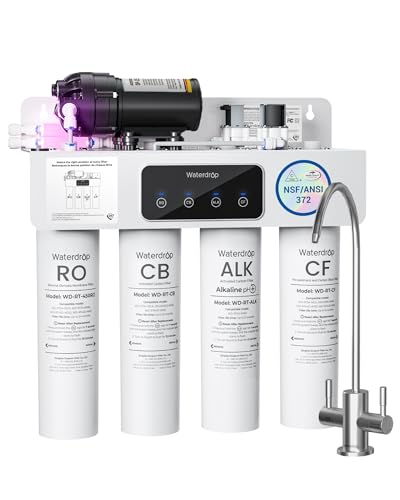
Waterdrop WD-T4-A 450 GPD Alkaline RO
Best for: Alkaline water seekers with space constraints
- Certification
- NSF Certified (what this guide is about)
- Filtration Stages
- 10
- Capacity (GPD)
- 450 GPD
- Design
- Under sink
- Pure to Drain Ratio
- 2:1
- Filtration Type
- Reverse osmosis, alkaline
View on Amazon: Waterdrop WD-T4-A 450 GPD Alkaline RO Affiliate link
This tankless under-sink system uses 10 filtration stages to reduce contaminants while adding alkaline minerals. It holds NSF/ANSI 372 certification for lead-free materials. The 450 GPD capacity and 2:1 pure-to-drain ratio offer efficient water use. You get dual flow options for standard or mineral-enhanced water. The compact design frees up under-sink space compared to tank-based units.
Pros
- NSF/ANSI 372 certification for material safety
- 450 GPD flow rate with 2:1 water-saving ratio
- 10-stage filtration with alkaline mineral enhancement
- Tankless design saves under-sink space
Cons
- Requires countertop drilling for faucet installation
- Needs electrical connection to operate
- Faucet installation requires specific hole drilling
Good fit if
- You want alkaline-enhanced drinking water
- You need a compact tankless system
- You prefer dual water flow options
Skip if
- You cannot drill holes in your countertop
- You have no electrical outlet under the sink
- You prefer a system with a built-in storage tank
Verdict: Waterdrop WD-T4-A 450 GPD Alkaline RO fits households wanting mineral-enhanced water in a compact footprint. It suits buyers who can drill countertops and have power under the sink.

Frizzlife SP99 Under Sink Filter
Best for: Certified lead and chlorine reduction under sinks
- Certification
- NSF Certified (what this guide is about)
- Design
- Under sink
- Filtration Type
- Water filtration
- Installation Type
- Under sink
- Features
- Brushed nickel faucet included
- Micron Rating
- 0.5 micron
View on Amazon: Frizzlife SP99 Under Sink Filter Affiliate link
The Frizzlife SP99 is an under sink water filter system certified against NSF/ANSI 42, 53, and 372 standards. It uses 8-layer 0.5 micron filtration to reduce lead, chlorine, and particulates while retaining beneficial minerals. The unit includes a brushed nickel faucet and measures 15 by 5 by 14 inches. You get a dedicated faucet option or direct connection. It fits under most sinks and saves space compared to bulkier models.
Pros
- Certified to NSF/ANSI 42, 53, and 372 standards
- 0.5 micron filtration accuracy removes lead and chlorine
- Includes a lead-free brushed nickel faucet
- Compact design saves up to 50% of cabinet space
Cons
- 0.5 micron rating is less precise than 0.01 micron ultra-filtration
- Does not reduce Total Dissolved Solids (TDS)
- No remote control or smart connectivity features
Good fit if
- You want NSF certified protection against lead and chlorine
- You need a compact unit that fits under tight sinks
- You prefer a system that retains beneficial minerals
Skip if
- You require reverse osmosis to remove TDS and minerals
- You need ultra-filtration with 0.01 micron precision
- You want a gravity-fed or countertop unit
Verdict: Frizzlife SP99 Under Sink Filter offers certified lead and chlorine reduction for buyers who want mineral retention. It suits those prioritizing compact installation and standard contaminant removal over deionization.

CuZn UC-200 5-Year Under Sink Filter
Best for: Long-lasting under-sink contaminant reduction
- Certification
- NSF Certified (what this guide is about)
- Filtration Stages
- 3
- Design
- Under sink
- Contaminants Removed
- PFAS, PFOS, PFOA, lead, chlorine
- Installation Type
- Under sink
- Features
- Chlorine Reduction
View on Amazon: CuZn UC-200 5-Year Under Sink Filter Affiliate link
The CuZn UC-200 is a three-stage under-sink water filter with NSF/ANSI 42 and 372 certifications. It uses KDF-55 and coconut shell carbon to remove chlorine, lead, and PFAs while keeping beneficial minerals. The unit measures 15 inches tall and offers a five-year filter life. It suits you if you want certified contaminant reduction without the complexity of reverse osmosis or mineral removal.
Pros
- NSF/ANSI 42 and 372 certified for safety and quality
- Five-year filter life reduces replacement frequency
- Three-stage filtration removes lead, PFAs, and chlorine
- Retains beneficial minerals in drinking water
Cons
- Does not reduce Total Dissolved Solids (TDS)
- Requires under-sink installation space
- Limited to three filtration stages
Good fit if
- You want NSF-certified contaminant reduction
- You prefer to keep beneficial minerals
- You want a low-maintenance filter
Skip if
- You need to reduce TDS levels
- You require reverse osmosis purification
- You want a countertop unit
Verdict: CuZn UC-200 Under Sink Filter is a practical option for buyers who need certified contaminant reduction without the mineral stripping of reverse osmosis. It fits households prioritizing long filter life and simple maintenance.
Specifications side by side
| Spec | iSpring RCC7-BN 75 GPD Under Sink RO | Purewell Gravity Countertop Filter 3-Stage | AquaTru Countertop RO System | Waterdrop WD-T4-A 450 GPD Alkaline RO | Frizzlife SP99 Under Sink Filter | CuZn UC-200 5-Year Under Sink Filter |
|---|---|---|---|---|---|---|
| Filtration Stages | 5 | 3 | not stated | 10 | not stated | 3 |
| Capacity (GPD) | 75 | not stated | not stated | 450 GPD | not stated | not stated |
| Design | Under sink | Countertop | Countertop | Under sink | Under sink | Under sink |
| Pure to Drain Ratio | not stated | not stated | not stated | 2:1 | not stated | not stated |
| Certification | NSF/ANSI 58 | NSF/ANSI 42, 372 | NSF/ANSI 41, 53, 58, 401, P473 | NSF/ANSI 372 | NSF/ANSI 42&53&372 | NSF/ANSI 42, NSF/ANSI 372 |
| Filtration Type | Reverse osmosis | not stated | Reverse osmosis | Reverse osmosis, alkaline | Water filtration | not stated |
| Contaminants Removed | not stated | not stated | not stated | not stated | not stated | PFAS, PFOS, PFOA, lead, chlorine |
| Installation Type | Under sink | Countertop | Countertop | Under sink | Under sink | Under sink |
| Features | not stated | not stated | not stated | not stated | Brushed nickel faucet included | not stated |
| Micron Rating | 0.0001 | 0.01 microns | not stated | not stated | 0.5 micron | not stated |
| Capacity | 75 GPD | not stated | not stated | not stated | not stated | not stated |
| Use | Drinking Water | not stated | not stated | not stated | not stated | not stated |
| Color | Brushed Nickel Faucet | Silver | AquaTru | White - Alkaline Water | White | Black |
| Dimensions | 15 × 8 × 18 inches | 8.9 × 8.9 × 20 inches | 14 × 12 × 14 inches | 16.5 × 6.22 × 18 inches | 15 × 5 × 14 inches | 4.5 × 4.5 × 15 inches |
| Weight | 27.5 pounds | 8.5 pounds | 22.8 pounds | 24.2 pounds | 8.55 pounds | not stated |
| Size | Regular | Large | not stated | 450 GPD | With Dedicated Faucet | 5-Year |
| Model | RCC7-BN | K8626 | AQT Classic | WD-RT44D-WAD | SP99 | UC-200 |
Frequently asked questions
What does NSF certification actually mean for an RO system?
It means the system has been tested by an independent lab to meet specific safety and performance standards. This verification ensures the unit does not leach harmful chemicals into your water. It also confirms the system removes contaminants at the rates advertised by the manufacturer. You get peace of mind that the filtration process is reliable.
Why is NSF/ANSI 58 important for reverse osmosis?
NSF/ANSI 58 is the primary standard specifically for reverse osmosis systems. It verifies that the unit reduces contaminants like lead, arsenic, and nitrates effectively. It also checks the structural integrity of the system to prevent leaks or failures. Look for this number on the label to ensure your water is safe and the unit is built to last.
Does NSF certification cover taste and odor improvement?
Yes, but under a different standard. NSF/ANSI 42 covers aesthetic effects, including taste and odor. It ensures that carbon filters in the system remove chlorine effectively. While NSF/ANSI 58 focuses on health-related contaminants, this standard guarantees your water will not taste or smell like chemicals. Many certified systems include both standards for comprehensive protection.
Are all certified RO systems under sink?
No. Certification applies to various installation types. For example, the Purewell Gravity Countertop Filter is NSF certified and requires no plumbing. The AquaTru Countertop RO System is also certified for renters who cannot drill holes. You can find certified options for under-sink, countertop, and gravity-fed systems depending on your space and needs.
Can certified systems handle high daily water usage?
Yes, some certified models offer high capacity. The iSpring RCC7-BN provides 75 gallons per day, fitting families with high demand. The Waterdrop WD-T4-A offers 450 gallons per day in a compact, tankless design. These systems maintain their certification while delivering large volumes of purified water. Check the GPD rating to ensure it matches your household size.
Do certified filters retain minerals in the water?
Some certified systems are designed to retain or add minerals. The Frizzlife SP99 offers certified lead and chlorine reduction while keeping beneficial minerals. The Waterdrop WD-T4-A includes an alkaline filter to enhance mineral content. These options suit buyers who want certified safety without the mineral stripping typical of standard reverse osmosis. Look for alkaline or mineral-retention features in the specs.