What Is Design? A Guide for Reverse Osmosis Systems Buyers (2026)
As an Amazon Associate we earn from qualifying purchases. Links on this page are affiliate links.
Tankless Design Explained
When you browse for reverse osmosis systems, you will often see the term tankless. This design explained feature refers to a filtration unit that operates without a large storage tank. Traditional systems rely on a pressurized bladder tank to hold purified water for later use. Tankless models skip this component entirely.
Instead, these units filter water on demand. The process happens inside the housing as water flows through the membranes. You get fresh water only when you turn on the faucet. This immediate flow changes how you interact with your kitchen plumbing. There is no waiting for a tank to refill after you use a glass of water.
You will find this specification labeled as tankless, compact, or under-sink direct flow on product listings. It is a key part of the overall design explained for modern buyers. The absence of a tank means the unit takes up less space under your sink. This is critical in smaller kitchens where cabinet space is limited.
Why does this matter to you? The primary benefit is space efficiency. You gain valuable storage area because there is no bulky tank to accommodate. Additionally, water quality remains consistent. Without a storage tank, there is no risk of stale water sitting in a bladder for days. The water is always fresh from the membrane.
However, flow rate is a different concern. Tankless units often have slower flow rates than tanked systems. You must check the gallons per minute specification. This tells you how fast you can fill a pitcher or pot. If you need large volumes quickly, a slower flow might be inconvenient.
Understanding the design explained helps you weigh space savings against flow speed. It is a trade-off between convenience and capacity. Most buyers choose tankless for the footprint reduction. Others prefer the faster refill times of tanked models. Your choice depends on your specific kitchen layout and usage habits.
Tankless RO System Options
Tankless
Tankless systems operate without a storage tank, delivering water directly through the membrane. This design saves significant cabinet space and ensures fresh water is never stored. You must check the flow rate, as tankless units rely on membrane speed. Higher GPD ratings like the Waterdrop G3P600 or G3P800 provide better flow for daily use. The iSpring RO500-BN offers certified purification for those prioritizing standard filtration. For specialized needs, the iSpring RCC1DP provides deionization without a tank. Consider electrical access, as many tankless models require power for booster pumps. Dimensions vary; the Waterdrop G2 is compact, while the iSpring RO500-BN is taller. This design suits space-constrained kitchens and users who prefer continuous filtration over stored volume.
Tankless
Tankless designs remove the need for a pressurized storage tank, freeing up under-sink space. You get water on demand, filtered directly from the membrane. Flow rate depends on the system’s GPD capacity. The Waterdrop G3P600 and G3P800 offer high capacity for large households. The Waterdrop WD-T4-A adds alkaline filtration for mineral-enhanced water. The iSpring RCC1DP is specialized for ultra-pure water needs. Most tankless systems require electricity for booster pumps to maintain pressure. Check dimensions carefully; the iSpring RO500-BN is wider and taller than others. This option suits buyers with limited cabinet space who want consistent, fresh water. It is less ideal for areas with low water pressure unless a booster pump is included. Verify power availability before choosing a tankless model.
Tankless Design Worth It?
Who needs it
You should prioritize a tankless reverse osmosis system if cabinet space is at a premium. These units eliminate the bulky storage tank, freeing up valuable under-sink room for other items. This design is ideal for smaller kitchens or tight utility closets where traditional systems simply will not fit. Additionally, if you are concerned about water stagnation, tankless systems provide water on demand. This means purified water is never stored for long periods, reducing the risk of bacterial growth or taste changes. You get fresh water directly from the membrane. This is also a strong choice if you want a sleeker aesthetic without visible tanks. However, you must ensure your household has a consistent demand for purified water. The flow rate may be slower than tanked systems, so check the specifications to see if the output speed meets your daily needs. If you need large volumes quickly, verify the GPD rating carefully.
Who can skip it
You can skip the tankless design if you require high-volume water delivery for multiple tasks simultaneously. Tankless systems often have lower flow rates compared to tanked models with storage. If you frequently fill large pots, bathe pets, or host gatherings, a tanked system ensures you always have a reservoir of purified water ready. You do not need to wait for the membrane to filter water in real-time. Additionally, if your household has limited counter space but ample under-sink storage, a traditional tank might be more practical. You can prioritize a system with a higher flow rate and larger capacity instead. Focus on checking the gallons per day rating and the tank size. This approach ensures you never run out of water during peak usage times. Tankless units are less necessary if you do not mind the extra footprint in exchange for convenience and speed.
RO System Glossary
Filtration Stages
The number of distinct filters in the system. More stages usually mean higher purity by removing more contaminants from the water.
Pure to Drain Ratio
The amount of clean water produced for every gallon of wastewater sent to the drain. A 1:1 ratio is more efficient than 1:3.
Capacity
The daily volume of purified water the system can produce, typically measured in gallons per day. Higher capacity suits larger households.
Installation Type
How the system mounts in your home. Under-sink models hide inside cabinets, while countertop units sit on the counter surface.
Certification
Independent verification that the system meets specific safety and performance standards. Look for NSF or WQA marks on the product.
Features
Additional capabilities beyond basic filtration. These include smart leak detection, auto-flush cycles, or digital flow meters for monitoring water usage.
Design
The physical form and layout of the unit. Compact designs fit tight spaces, while modular designs allow for easy filter replacement.
Use
The intended application for the purified water. Some systems are optimized for drinking only, while others support whole-house or ice maker use.
Quick picks
| # | Product | Best for | Price |
|---|---|---|---|
| 1 | Waterdrop G3P600 600 GPD Tankless RO | High-flow tankless filtration with digital monitoring | Check price of Waterdrop G3P600 600 GPD Tankless RO on Amazon |
| 2 | Waterdrop G2 400 GPD Tankless RO | Space-constrained kitchens needing water efficiency | Check price of Waterdrop G2 400 GPD Tankless RO on Amazon |
| 3 | Waterdrop WD-T4-A 450 GPD Alkaline RO | Alkaline water seekers with space constraints | Check price of Waterdrop WD-T4-A 450 GPD Alkaline RO on Amazon |
| 4 | Waterdrop G3P800 Tankless RO System | High-capacity tankless water purification | Check price of Waterdrop G3P800 Tankless RO System on Amazon |
| 5 | iSpring RO500-BN Tankless RO System | Tankless RO buyers needing NSF 58 certification | Check price of iSpring RO500-BN Tankless RO System on Amazon |
| 6 | iSpring RCC1DP Tankless 150 GPD | Specialized low-volume purification needs | Check price of iSpring RCC1DP Tankless 150 GPD on Amazon |
Our 6 picks

Waterdrop G3P600 600 GPD Tankless RO
Best for: High-flow tankless filtration with digital monitoring
- Design
- Tankless (what this guide is about)
- Filtration Stages
- 8
- Capacity (GPD)
- 600 GPD
- Pure to Drain Ratio
- 2:1
- Certification
- NSF/ANSI 42, 53, 58, 372
- Filtration Type
- Reverse osmosis
View on Amazon: Waterdrop G3P600 600 GPD Tankless RO Affiliate link
The Waterdrop G3P600 is a tankless reverse osmosis system with a 600 GPD capacity. It features an 8-stage filtration process and a smart display faucet that shows TDS levels and filter life. The unit saves 70% of under-sink space and uses a 2:1 drain ratio. You get clean water without a storage tank, but it requires an electrical outlet for operation.
Pros
- 600 GPD tankless capacity
- 8-stage filtration reduces TDS, PFAS, and lead
- Smart display faucet tracks TDS and filter life
- 2:1 low drain ratio saves water
- NSF/ANSI 58 and 372 certified
Cons
- Requires under-sink electricity
- Bulky dimensions (18.1"L x 5.67"W x 17.72"H)
- No mention of a bypass valve or manual TDS adjustment
Good fit if
- You need high daily water output without a tank
- You want real-time water quality monitoring via the faucet display
- You have space for a unit nearly 18 inches long
Skip if
- You cannot install an electrical outlet under your sink
- You have very narrow or shallow cabinet dimensions
- You prefer a system with a built-in storage tank
Verdict: Waterdrop G3P600 Tankless RO System fits households that need fast, tankless water with quality tracking. It suits those with adequate cabinet space and electrical access, but not those with tight spatial constraints.

Waterdrop G2 400 GPD Tankless RO
Best for: Space-constrained kitchens needing water efficiency
- Design
- Tankless (what this guide is about)
- Filtration Stages
- 7
- Capacity (GPD)
- 400 GPD
- Pure to Drain Ratio
- 1:1
- Certification
- NSF/ANSI 372
- Filtration Type
- Reverse Osmosis
View on Amazon: Waterdrop G2 400 GPD Tankless RO Affiliate link
The Waterdrop G2 is a tankless reverse osmosis system with a 400 GPD capacity. It features seven filtration stages and holds NSF/ANSI 372 certification for lead-free materials. The unit maintains a 1:1 pure-to-drain ratio, which reduces water waste. Its compact dimensions of 17.3 by 5.9 by 14 inches save under-sink space. You need an electrical outlet for operation. This system suits those prioritizing space efficiency and water conservation.
Pros
- NSF/ANSI 372 certified for lead-free materials
- 1:1 pure to drain ratio saves water
- 7-stage filtration with composite filter
- Compact tankless design saves 70% space
Cons
- Requires an electrical outlet for operation
- 400 GPD capacity is lower than 600 or 800 GPD alternatives
- Needs drilling holes for installation
Good fit if
- You need a compact unit that saves under-sink space
- You want a system with a low water waste ratio
- You value NSF certification for material safety
Skip if
- You require a higher flow rate than 400 GPD
- You cannot install an electrical outlet under your sink
- You prefer a system with a storage tank
Verdict: Waterdrop G2 400 GPD Tankless RO fits users who need a space-saving, water-efficient system with certified materials. It is ideal for smaller kitchens where tankless designs are preferred over bulky tanks.
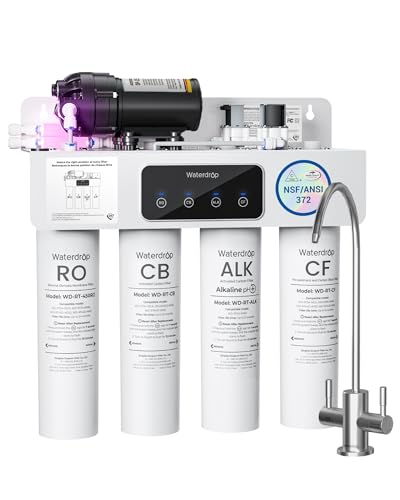
Waterdrop WD-T4-A 450 GPD Alkaline RO
Best for: Alkaline water seekers with space constraints
- Design
- Tankless (what this guide is about)
- Filtration Stages
- 10
- Capacity (GPD)
- 450 GPD
- Pure to Drain Ratio
- 2:1
- Certification
- NSF/ANSI 372
- Filtration Type
- Reverse osmosis, alkaline
View on Amazon: Waterdrop WD-T4-A 450 GPD Alkaline RO Affiliate link
This tankless system offers 450 GPD capacity with a 2:1 pure-to-drain ratio. It features 10-stage filtration and an alkaline mineralizer for pH+ water. The unit requires under-sink drilling and an electrical connection. It saves space compared to tank-based models. This system suits you if you want mineral-enhanced water without a storage tank.
Pros
- 450 GPD flow rate
- 2:1 pure to drain ratio
- 10-stage filtration with alkaline mineralizer
- NSF/ANSI 372 certified
- Tankless design saves space
Cons
- Requires countertop drilling for faucet
- Needs electrical connection
- Heavier at 24.2 pounds
Good fit if
- You want alkaline mineral water
- You need a tankless system
- You have under-sink power access
Skip if
- You cannot drill countertops
- You lack electrical outlets under the sink
- You prefer standard RO water only
Verdict: Waterdrop WD-T4-A Alkaline 450 GPD fits users who prioritize mineral-enhanced water and space savings. It is ideal for those who can handle installation drilling and have power available under the sink.
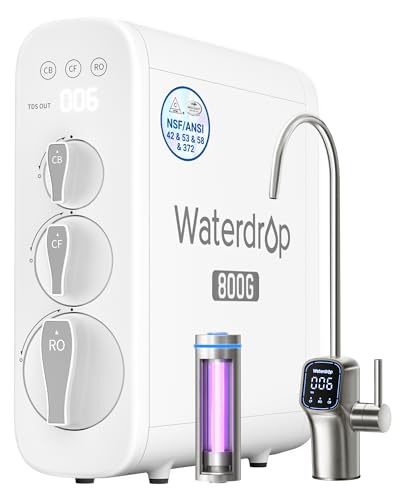
Waterdrop G3P800 Tankless RO System
Best for: High-capacity tankless water purification
- Design
- Tankless (what this guide is about)
- Filtration Stages
- 10
- Capacity (GPD)
- 800
- Pure to Drain Ratio
- 3:1
- Certification
- NSF 42, NSF 53, NSF 58, NSF 372
- Filtration Type
- Reverse osmosis
View on Amazon: Waterdrop G3P800 Tankless RO System Affiliate link
The Waterdrop G3P800 is a tankless reverse osmosis system with an 800 gallons per day capacity. It uses a 10-stage filtration process and holds NSF/ANSI 42, 53, 58, and 372 certifications. The unit includes a smart faucet with a TDS display. It saves under-sink space while delivering high flow rates. This system suits households needing substantial pure water output without the bulk of a storage tank.
Pros
- 800 GPD capacity for high daily water output
- NSF/ANSI 42, 53, 58, and 372 certified
- Smart faucet displays real-time TDS levels
- 10-stage filtration reduces PFAS and heavy metals
- 3:1 pure to drain ratio improves efficiency
Cons
- No built-in storage tank requires immediate usage
- Lacks a dedicated post-carbon polishing stage in the listed filtration chain
- Smart faucet relies on LED power rather than a rechargeable battery
Good fit if
- You need a high-flow system for a large family
- You want verified NSF certifications for safety
- You prefer seeing water quality data on the faucet
Skip if
- You require a system with a built-in storage tank
- You need a faucet with a digital screen beyond TDS
- You have limited under-sink space smaller than 18 inches
Verdict: Waterdrop G3P800 800 GPD Tankless RO fits buyers who prioritize high capacity and certified filtration over stored water availability. It delivers consistent pure water for large households without occupying extra cabinet space.

iSpring RO500-BN Tankless RO System
Best for: Tankless RO buyers needing NSF 58 certification
- Design
- Tankless (what this guide is about)
- Capacity (GPD)
- 500 GPD
- Pure to Drain Ratio
- 2:1
- Certification
- NSF 58
- Filtration Type
- Reverse osmosis
- Features
- Automatic self cleaning mode
View on Amazon: iSpring RO500-BN Tankless RO System Affiliate link
The iSpring RO500-BN is a tankless reverse osmosis system with 500 GPD capacity. It holds NSF 58 certification for TDS reduction. The unit features a 2:1 pure-to-drain ratio and automatic self-cleaning. Its dimensions are 8 by 19 by 24 inches. This system suits households needing steady flow without a storage tank. It fits under most standard sinks.
Pros
- NSF 58 certified for TDS reduction
- 500 GPD fast flow rate
- 2:1 pure to drain ratio
- Automatic self-cleaning mode
Cons
- 150 GPD DI option not included
- No alkaline remineralization stage
- Heavier at 21 pounds
Good fit if
- You want NSF 58 certification
- You need a 2:1 water ratio
- You prefer tankless designs
Skip if
- You require alkaline water
- You need DI filtration
- You want a lighter unit
Verdict: The iSpring RO500-BN 500 GPD Tankless RO delivers certified purification with efficient water usage. It fits buyers who prioritize tankless efficiency and standard RO filtration over added mineral stages.

iSpring RCC1DP Tankless 150 GPD
Best for: Specialized low-volume purification needs
- Design
- Tankless (what this guide is about)
- Filtration Stages
- 5
- Capacity (GPD)
- 150
- Contaminants Removed
- Chlorine, fluoride, lead
- Features
- Booster pump
- Dimensions
- 14.2 × 8.5 × 17.7 inches
View on Amazon: iSpring RCC1DP Tankless 150 GPD Affiliate link
The iSpring RCC1DP is a tankless RO/DI system with a 150 GPD capacity and integrated booster pump. It uses five filtration stages, including a deionization filter, to reduce total dissolved solids to 0-1 ppm. This design suits aquariums, labs, and dental facilities where spot-free water is critical. Its compact dimensions allow for under-sink installation without a storage tank, making it a practical option for specialized water purification needs.
Pros
- Integrated booster pump for consistent flow in low-pressure environments
- Deionization filter reduces TDS to 0-1 ppm
- Tankless design saves space under the sink
- 5-stage filtration removes lead, chlorine, and fluoride
Cons
- 150 GPD capacity is lower than other tankless models on this list
- No storage tank included for immediate high-volume use
- Only 1-year limited warranty coverage
Good fit if
- You need deionized water for aquariums or labs
- You have low water pressure and need a pump
- You want a tankless system for space savings
Skip if
- You need high-volume water for a large family
- You require a larger 400 GPD or 800 GPD capacity
- You prefer a system with a storage tank
Verdict: iSpring RCC1DP Tankless RO/DI System is a specialized unit for users needing ultra-pure, deionized water for technical or hobbyist applications rather than general household drinking water.
Specifications side by side
| Spec | Waterdrop G3P600 600 GPD Tankless RO | Waterdrop G2 400 GPD Tankless RO | Waterdrop WD-T4-A 450 GPD Alkaline RO | Waterdrop G3P800 Tankless RO System | iSpring RO500-BN Tankless RO System | iSpring RCC1DP Tankless 150 GPD |
|---|---|---|---|---|---|---|
| Filtration Stages | 8 | 7 | 10 | 10 | not stated | 5 |
| Capacity (GPD) | 600 GPD | 400 GPD | 450 GPD | 800 | 500 GPD | 150 |
| Design | Tankless | Tankless | Under sink | Tankless, under sink | Tankless | Tankless |
| Pure to Drain Ratio | 2:1 | 1:1 | 2:1 | 3:1 | 2:1 | not stated |
| Certification | NSF/ANSI 42, 53, 58, 372 | NSF/ANSI 372 | NSF/ANSI 372 | NSF 42, NSF 53, NSF 58, NSF 372 | NSF 58 | not stated |
| Filtration Type | Reverse osmosis | Reverse Osmosis | Reverse osmosis, alkaline | Reverse osmosis | Reverse osmosis | not stated |
| Contaminants Removed | TDS, chromium, PFAS, radium, fluoride | not stated | not stated | PFAS, fluoride, lead, chromium, iron | not stated | Chlorine, fluoride, lead |
| Installation Type | Under-sink | Under sink | Under sink | Under sink | not stated | not stated |
| Features | Smart display faucet, TDS monitor | not stated | not stated | Smart faucet, LED function | Automatic self cleaning mode | Booster pump |
| Capacity | not stated | 400 GPD | not stated | 800 GPD | not stated | not stated |
| Color | White | White | White - Alkaline Water | White | White + Brushed Nickel Faucet | not stated |
| Dimensions | 18.1 × 5.68 × 17.8 inches | 17.3 × 5.9 × 14 inches | 16.5 × 6.22 × 18 inches | 18.1 × 5.67 × 17.7 inches | 19 × 8 × 24 inches | 14.2 × 8.5 × 17.7 inches |
| Weight | 31 pounds | 25 pounds | 24.2 pounds | 33.7 pounds | 21 pounds | 20 pounds |
| Size | 600 GPD | 400 GPD | 450 GPD | 800 GPD | NSF 500 GPD RO | not stated |
| Model | WD-G3 | WD-G2-W | WD-RT44D-WAD | WD-G3P800-W | RO500 | rcc1d |
Frequently asked questions
How much space does a tankless RO system take up?
Tankless units are compact and fit under most sinks. The Waterdrop G2 measures 5.9 inches wide and 14 inches high. The iSpring RO500-BN is slightly larger at 8 inches wide and 24 inches high. You save cabinet space by removing the bulky storage tank. These dimensions allow for flexible installation in tight areas.
Do tankless reverse osmosis systems need electricity?
Many tankless models require power for booster pumps or digital displays. The Waterdrop G3P600 includes digital monitoring, which needs an electrical outlet. The iSpring RCC1DP uses a booster pump for its deionization stage. You must have power available under the sink for these specific units to operate correctly.
What is the difference between 400 GPD and 600 GPD capacity?
GPD stands for gallons per day, indicating daily production volume. A 400 GPD unit, like the Waterdrop G2, suits smaller households with moderate usage. A 600 GPD model, such as the Waterdrop G3P600, provides faster flow for larger families. Higher GPD ratings deliver water more quickly to your faucet.
Are tankless RO systems certified for safety?
Some tankless systems carry specific safety certifications. The iSpring RO500-BN holds NSF 58 certification for material safety and contaminant reduction. The Waterdrop WD-T4-A is also NSF certified. These certifications verify that the system materials and filtration performance meet established industry standards for drinking water quality.
Can tankless systems produce alkaline water?
Yes, certain tankless models include alkaline filters. The Waterdrop WD-T4-A features a 10-stage filtration process with an alkaline filter. This adds minerals back into the purified water to raise pH levels. It offers mineral-enhanced water without requiring a storage tank for the final product.
What is the pure to drain ratio in tankless systems?
The ratio shows how much clean water you get per gallon of wastewater. The iSpring RO500-BN has a 2:1 pure to drain ratio. The Waterdrop WD-T4-A also maintains a 2:1 ratio. This metric helps you understand water efficiency during the filtration process.
Do tankless systems include deionization stages?
Specialized tankless units offer deionization for ultra-pure water. The iSpring RCC1DP is a RO/DI system with a deionization stage. It is designed for technical or hobbyist applications rather than general drinking. This feature removes remaining ions for the highest level of purity.