Filtration Stages Explained: What It Means for Reverse Osmosis Systems
As an Amazon Associate we earn from qualifying purchases. Links on this page are affiliate links.
Filtration Stages Explained Simply
You will see filtration stages explained in product listings as a number, such as 2-Stage, 3-Stage, or up to 10-Stage. This number tells you how many separate filter units are inside the system. Each stage targets specific contaminants. Understanding this helps you choose the right level of purification for your home water.
A 2-Stage system is the most basic. It usually includes a sediment pre-filter and a carbon block filter. This setup removes large particles like sand and chlorine. It improves taste but does not remove dissolved minerals or heavy metals. You should consider this only if your municipal water is already very clean.
A 3-Stage system adds a reverse osmosis membrane. This is the core component. The membrane forces water through a tiny pore, blocking lead, arsenic, and nitrates. This is the standard entry point for effective RO filtration. Most buyers look for at least this level.
A 5-Stage system is the most common configuration. It typically adds a post-carbon filter after the membrane. This final step polishes the water, ensuring no residual taste. It also often includes a remineralization stage to add healthy minerals back into the purified water. This balance of purity and taste is why 5-Stage systems are popular.
Higher counts like 6-Stage, 8-Stage, or 10-Stage add more specialized filters. These might include UV light for bacteria, additional carbon blocks for VOCs, or extra sediment pre-filters. More stages do not always mean better water. They often mean higher maintenance costs and more frequent filter changes. You must check what each specific stage does. Do not assume a 10-Stage system is superior to a 5-Stage system without reading the details. Focus on the membrane quality and the specific contaminants each listed stage removes. This approach ensures you get the protection you need without paying for unnecessary complexity.
Compare Filtration Stage Options
2-Stage
A 2-Stage system uses two separate filter units to target specific contaminants. This setup is common in systems designed for certified lead and PFAS reduction, such as the A. O. Smith AO-US-200. It offers targeted purification without the complexity of reverse osmosis membranes. You get verified safety for small households. The trade-off is limited scope. It does not remove all dissolved solids or provide the broad spectrum cleaning of multi-stage RO units. Choose this if you need specific contaminant removal and have limited space or budget for a full RO system.
3-Stage
Three filtration stages provide a balance between flow speed and contaminant removal. The iSpring US31-NC exemplifies this with a 3-Stage Under Sink Filter. It is ideal for users who prioritize fast water flow and mineral retention. This system effectively removes chlorine and chloramine while keeping beneficial minerals in the water. It suits those with municipal water issues who do not require the intensive purification of reverse osmosis. The trade-off is that it does not remove dissolved solids like fluoride or heavy metals. It is a practical choice for general taste improvement and basic safety.
5-Stage
Five stages represent the standard for comprehensive reverse osmosis purification. Systems like the iSpring RCC7-BN and APEC ROES-50 use this configuration. The process typically includes sediment, carbon, and RO membrane stages, followed by post-filtration. This setup delivers certified purity and removes a wide range of contaminants. It fits standard households needing reliable drinking water. The trade-off is the inclusion of a storage tank in many models, which limits flow speed and requires under-sink space. You get consistent, high-quality water but with slower replenishment rates compared to tankless designs.
8-Stage
Eight stages indicate a more complex filtration path, often found in gravity-fed or ultrafiltration systems. The Purewell PW-OB-CF uses an 8-Stage Countertop UF System. This design is suitable for users who need fluoride reduction without plumbing connections. It relies on gravity rather than pressure, making it portable and easy to install. The multiple stages allow for thorough filtering of particulates and chemicals. The trade-off is significantly slower filtration speed. You must wait for gravity to pull water through the filters. It is best for small households or emergency preparedness where convenience and portability outweigh the need for high-volume, fast water.
10-Stage
Ten stages offer the most advanced filtration available, often including remineralization and alkaline features. The Waterdrop WD-T4-A is a 10-Stage RO system that produces alkaline water. It removes contaminants while adding beneficial minerals back into the water. This system is tankless, providing high flow rates without storage tank limitations. It suits users who want premium water quality and speed. The trade-off is higher complexity and cost. It requires drilling for a dedicated faucet and access to power. It is ideal for kitchens where you want the highest level of purification and taste enhancement in a modern, compact design.
Do You Need More Stages
Who needs it
You should prioritize systems with higher filtration stages if your water source presents complex contamination challenges. Systems with five, six, eight, or even ten stages offer progressive purification. The additional filters remove specific contaminants that simpler setups might miss. If you rely on well water, you likely face a broader range of impurities. Sediment, chlorine, heavy metals, and dissolved solids require distinct removal steps. More stages mean each filter handles a smaller, specific load. This extends the life of the membrane and improves overall water quality. You benefit from this configuration when you want maximum purity for drinking and cooking. It is ideal for households concerned about multiple pollutant types. The extra filtration provides peace of mind for sensitive users. You get cleaner water by addressing every potential contaminant source systematically.
Who can skip it
You can skip complex multi-stage systems if your water is already municipally treated and safe. A three-stage or two-stage setup often suffices for standard city water. These simpler systems handle basic chlorine, sediment, and general taste issues effectively. You save money on initial costs and future filter replacements. Fewer stages mean less counter space required under your sink. Maintenance becomes easier with fewer components to monitor and change. Prioritize flow rate and tank capacity if you have a large family. You might prefer faster water production over marginal purity gains. Check your local water quality report first. If contaminants are low, advanced filtration is unnecessary. Focus on reliable membrane quality instead of stage count. Simplicity offers reliability and lower ongoing maintenance effort for most urban users.
Key Filtration Terms
Filtration Stages
The count of separate filter units in a system. Each stage targets specific contaminants, providing progressive purification for cleaner drinking water.
Pre-filters
Initial filters that remove sediment and chlorine. They protect the delicate reverse osmosis membrane from damage and extend its operational lifespan.
RO Membrane
The core component that removes dissolved solids. It forces water through a semi-permeable barrier to separate pure water from contaminants.
Post-filter
A final carbon filter added after the membrane. It improves taste and odor by polishing the water before it reaches your faucet.
Capacity
The daily volume of pure water a system produces. Higher capacity means faster refill rates for your storage tank and kitchen tasks.
Pure to Drain Ratio
The efficiency metric comparing purified water to wastewater. A higher ratio indicates less water waste during the filtration process.
Certification
Independent verification that a system meets specific standards. Look for NSF or WQA marks to ensure performance claims are accurate and safe.
Installation Type
How the system mounts in your home. Common options include under-sink units for space efficiency or countertop models for rental flexibility.
Quick picks
| # | Product | Best for | Price |
|---|---|---|---|
| 1 | iSpring RCC7-BN 75 GPD Under Sink RO | Standard households needing certified purity | Check price of iSpring RCC7-BN 75 GPD Under Sink RO on Amazon |
| 2 | Purewell 8-Stage Countertop Gravity Filter | Fluoride reduction without plumbing | Check price of Purewell 8-Stage Countertop Gravity Filter on Amazon |
| 3 | Waterdrop WD-T4-A 450 GPD Alkaline RO | High-flow alkaline water without a tank | Check price of Waterdrop WD-T4-A 450 GPD Alkaline RO on Amazon |
| 4 | iSpring US31-NC Under Sink Filter | Fast-flow chloramine removal without mineral loss | Check price of iSpring US31-NC Under Sink Filter on Amazon |
| 5 | A. O. Smith 2-Stage Under Sink Filter | Small households needing certified lead and PFAS reduction | Check price of A. O. Smith 2-Stage Under Sink Filter on Amazon |
| 6 | APEC ROES-50 5-Stage Under Sink RO | Standard 5-stage under sink filtration needs | Check price of APEC ROES-50 5-Stage Under Sink RO on Amazon |
Our 6 picks

iSpring RCC7-BN 75 GPD Under Sink RO
Best for: Standard households needing certified purity
- Filtration Stages
- 5-Stage (what this guide is about)
- Capacity (GPD)
- 75
- Design
- Under sink
- Certification
- NSF/ANSI 58
- Filtration Type
- Reverse osmosis
- Installation Type
- Under sink
View on Amazon: iSpring RCC7-BN 75 GPD Under Sink RO Affiliate link
This under sink reverse osmosis system uses five filtration stages to remove contaminants down to 0.0001 microns. It produces 75 gallons per day and holds NSF/ANSI 58 certification. The unit measures 8 by 15 by 18 inches and weighs 27.5 pounds. You get a brushed nickel faucet and transparent first-stage housing for easy inspection. This model suits households needing reliable, certified drinking water without complex maintenance.
Pros
- NSF/ANSI 58 certified for quality standards
- 75 GPD capacity for daily use
- 0.0001 micron filtration removes 99% of contaminants
- Transparent first-stage housing for quick checks
Cons
- 5-stage setup lacks alkaline remineralization
- 75 GPD output is lower than high-flow alternatives
- No built-in water quality display or sensor
Good fit if
- You want NSF/ANSI 58 certified performance
- You need a compact under sink unit
- You prefer simple maintenance with transparent housing
Skip if
- You require alkaline remineralization stages
- You need high flow rates above 75 GPD
- You want a system with digital monitoring
Verdict: iSpring RCC7-BN 5-Stage RO System delivers certified purity and easy maintenance for standard household needs. It fits buyers who prioritize verified contaminant removal over remineralization or high-speed output.

Purewell 8-Stage Countertop Gravity Filter
Best for: Fluoride reduction without plumbing
- Filtration Stages
- 8-Stage (what this guide is about)
- Capacity (GPD)
- 1,000 gallons (filter life)
- Design
- Countertop
- Certification
- NSF/ANSI 42
- Filtration Type
- Ultra-filtration, gravity
- Micron Rating
- 0.01 μm
View on Amazon: Purewell 8-Stage Countertop Gravity Filter Affiliate link
This Purewell unit uses gravity-fed ultra-filtration with an 0.01 μm membrane across eight stages. It reduces chlorine and 90% of fluoride without electricity. The 304 stainless steel housing holds 1,000 gallons per filter cycle. You get clean water from tap without plumbing or power. It suits renters or those needing fluoride removal. The design is sturdy and includes a non-slip stand.
Pros
- 8-stage filtration with 0.01 μm hollow fiber membrane
- Reduces 90% of fluoride using specialized material
- Gravity-fed operation requires no electricity or plumbing
- NSF/ANSI 42 certified for chlorine reduction
- 304 stainless steel housing is durable and stylish
Cons
- Does not lower TDS values
- Gravity process is slower than pressure-driven RO
- Requires manual filling and emptying of containers
Good fit if
- You need to reduce fluoride without installing under-sink plumbing
- You want a portable system for indoor or outdoor use
- You prefer gravity filtration to avoid electricity costs
Skip if
- You require a system that reduces total dissolved solids
- You need high-volume water production for large households
- You want a permanently plumbed under-sink installation
Verdict: Purewell 8-Stage Countertop UF System is a solid choice for users who need fluoride reduction and portability without electrical or plumbing connections. It fits those who value simple gravity filtration over high-pressure reverse osmosis performance.
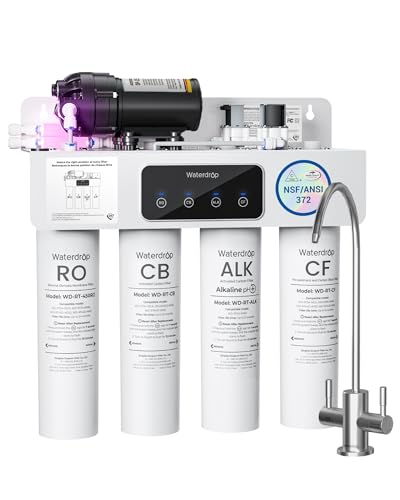
Waterdrop WD-T4-A 450 GPD Alkaline RO
Best for: High-flow alkaline water without a tank
- Filtration Stages
- 10-Stage (what this guide is about)
- Capacity (GPD)
- 450 GPD
- Design
- Under sink
- Pure to Drain Ratio
- 2:1
- Certification
- NSF/ANSI 372
- Filtration Type
- Reverse osmosis, alkaline
View on Amazon: Waterdrop WD-T4-A 450 GPD Alkaline RO Affiliate link
The Waterdrop WD-T4-A is a tankless under-sink reverse osmosis system with 10 filtration stages. It offers a 450 GPD capacity and a 2:1 pure-to-drain ratio. You can choose between standard RO water or an alkaline-enhanced stream. The unit requires an electrical connection and NSF/ANSI 372 certification for lead reduction. This compact design saves under-sink space while providing fast, on-demand purified water for your household.
Pros
- 10-stage filtration with alkaline mineral enhancement
- 450 GPD tankless design saves space
- 2:1 pure-to-drain water-saving ratio
- NSF/ANSI 372 certified for lead reduction
- Dual LED and buzzer filter life alerts
Cons
- Requires countertop drilling for faucet installation
- Needs electrical connection for operation
- Heavier at 24.2 pounds than basic models
Good fit if
- You want alkaline-enhanced drinking water
- You need a tankless system to save space
- You prefer a high flow rate of 450 GPD
Skip if
- You cannot drill holes in your countertop
- You need a system that does not require electricity
- You prefer a simpler 3-stage or 5-stage setup
Verdict: Waterdrop WD-T4-A 450 GPD 10-Stage RO suits users who want alkaline water and high flow without a storage tank. It fits kitchens where you can drill for the faucet and have power under the sink.

iSpring US31-NC Under Sink Filter
Best for: Fast-flow chloramine removal without mineral loss
- Filtration Stages
- 3-Stage (what this guide is about)
- Design
- Under sink
- Certification
- NSF/ANSI certified
- Contaminants Removed
- Chloramine, sediment, VOCs, chlorine
- Installation Type
- Under sink
- Features
- Sediment Filter
View on Amazon: iSpring US31-NC Under Sink Filter Affiliate link
The iSpring US31-NC is a 3-stage under-sink system designed for chloramine reduction. It uses NSF/ANSI 58 certified cartridges and SGS-tested catalytic carbon to remove sediments, VOCs, and chlorine. You get a high flow rate of up to 5 GPM and a capacity of 10,000 gallons. The clear housing lets you monitor captured particles. It retains beneficial minerals rather than lowering TDS, making it a distinct alternative to reverse osmosis systems.
Pros
- NSF/ANSI 58 certification for trusted safety
- SGS-tested catalytic carbon for chloramine reduction
- High flow rate of up to 5 GPM
- Clear housing shows captured particles
- Retains beneficial minerals in water
Cons
- Only 3 filtration stages compared to 5- or 8-stage RO systems
- Does not remove dissolved solids or lower TDS
- 1-year limited warranty is shorter than typical RO warranties
Good fit if
- You need fast flow rates for cooking and cleaning
- You want to retain beneficial minerals in your water
- You have chloramine-treated municipal water
Skip if
- You require full reverse osmosis filtration
- You want to remove dissolved solids
- You need a 5-stage or higher filtration system
Verdict: The iSpring US31-NC 3-Stage Under Sink Filter suits users who prioritize flow speed and mineral retention over comprehensive contaminant removal. It is a practical solution for those with chloramine issues who do not need RO-level filtration.

A. O. Smith 2-Stage Under Sink Filter
Best for: Small households needing certified lead and PFAS reduction
- Filtration Stages
- 2-Stage (what this guide is about)
- Design
- Under sink
- Certification
- NSF/ANSI 42, 43, 401, WQA
- Contaminants Removed
- Lead, PFAS, chlorine, mercury, asbestos
- Installation Type
- Under sink
- Features
- Chlorine Reduction
View on Amazon: A. O. Smith 2-Stage Under Sink Filter Affiliate link
The A. O. Smith AO-US-200 uses a 2-Stage Claryum filtration system to purify water directly from your sink. It reduces 99% of 78 harmful contaminants, including lead and PFAS, while keeping essential minerals. The unit is NSF/ANSI 42, 43, and 401 certified. It connects to a 3/8 inch cold water line and includes a dedicated faucet. This compact system suits households of 1 to 4 people who want certified protection without complex multi-stage setups.
Pros
- Reduces 99% of 78 harmful contaminants including lead and PFAS
- Certified to NSF/ANSI Standards 42, 43, and 401
- Filters water at 0.5 gallons per minute
- No water is wasted during the filtration process
Cons
- Only 2 filtration stages compared to 5- or 8-stage competitors
- System will not reduce Total Dissolved Solids (TDS)
- Does not include a remineralization or alkaline stage
Good fit if
- You want a simple, certified system without complex staging
- You need to reduce lead and pharmaceuticals specifically
- You prefer a compact unit that fits under small sinks
Skip if
- You require a dedicated reverse osmosis membrane for TDS reduction
- You want a high-capacity system for large families
- You need alkaline or pH+ water enhancement
Verdict: A. O. Smith AO-US-200 2-Stage Under Sink Filter offers targeted contaminant reduction with strong certifications. It is the right choice for small households prioritizing safety over mineral balance or high volume.

APEC ROES-50 5-Stage Under Sink RO
Best for: Standard 5-stage under sink filtration needs
- Filtration Stages
- 5-Stage (what this guide is about)
- Capacity (GPD)
- 50 GPD
- Design
- Under sink
- Certification
- NSF/ANSI 372, NSF/ANSI 58
- Filtration Type
- Reverse osmosis
- Contaminants Removed
- Arsenic, chlorine, lead, fluoride, PFAS
View on Amazon: APEC ROES-50 5-Stage Under Sink RO Affiliate link
The APEC Water ROES-50 is a 5-stage under sink reverse osmosis system with a 50 gallons per day capacity. It removes up to 99.99% of impurities, including arsenic, lead, and fluoride. The unit includes a storage tank, faucet, and installation kit. It measures 17 inches in height and weighs 24.9 pounds. This system suits households needing reliable, basic filtration without complex staging.
Pros
- 5-stage reverse osmosis filtration removes 99.99% of impurities
- 50 gallons per day production capacity
- Includes storage tank, faucet, and installation kit
- Quick connection fittings for DIY installation
Cons
- 50 GPD capacity is lower than high-flow alternatives
- Requires a dedicated storage tank for water supply
- Standard 5-stage setup lacks advanced alkaline or UV options
Good fit if
- You need a reliable 5-stage system for daily drinking water
- You prefer a complete kit with tank and faucet included
- You want a straightforward under sink installation
Skip if
- You require more than 50 gallons per day
- You want a tankless design for space saving
- You need advanced 7-stage or alkaline filtration
Verdict: APEC Water ROES-50 50 GPD Under Sink provides essential 5-stage purification for standard household needs. It fits users who prioritize proven, basic reverse osmosis performance over advanced staging features.
Specifications side by side
| Spec | iSpring RCC7-BN 75 GPD Under Sink RO | Purewell 8-Stage Countertop Gravity Filter | Waterdrop WD-T4-A 450 GPD Alkaline RO | iSpring US31-NC Under Sink Filter | A. O. Smith 2-Stage Under Sink Filter | APEC ROES-50 5-Stage Under Sink RO |
|---|---|---|---|---|---|---|
| Filtration Stages | 5 | 8 | 10 | 3-Stage | 2 | 5 |
| Capacity (GPD) | 75 | 1,000 gallons (filter life) | 450 GPD | not stated | not stated | 50 GPD |
| Design | Under sink | Countertop | Under sink | Under sink | Under sink | Under sink |
| Pure to Drain Ratio | not stated | not stated | 2:1 | not stated | not stated | not stated |
| Certification | NSF/ANSI 58 | NSF/ANSI 42 | NSF/ANSI 372 | NSF/ANSI certified | NSF/ANSI 42, 43, 401, WQA | NSF/ANSI 372, NSF/ANSI 58 |
| Filtration Type | Reverse osmosis | Ultra-filtration, gravity | Reverse osmosis, alkaline | not stated | not stated | Reverse osmosis |
| Contaminants Removed | not stated | not stated | not stated | Chloramine, sediment, VOCs, chlorine | Lead, PFAS, chlorine, mercury, asbestos | Arsenic, chlorine, lead, fluoride, PFAS |
| Installation Type | Under sink | not stated | Under sink | Under sink | Under sink | Under sink |
| Micron Rating | 0.0001 | 0.01 μm | not stated | not stated | not stated | not stated |
| Capacity | 75 GPD | not stated | not stated | not stated | not stated | 50 GPD |
| Features | not stated | Chlorine Reduction | Alkaline Filter | Sediment Filter | Chlorine Reduction | not stated |
| Use | Drinking Water | not stated | not stated | not stated | not stated | Drinking Water |
| Color | Brushed Nickel Faucet | Silver | White - Alkaline Water | Pure White - Plus | Filter System - AO-US-200 | White |
| Dimensions | 15 × 8 × 18 inches | 8.8 × 8.8 × 20 inches | 16.5 × 6.22 × 18 inches | 13 × 5.3 × 14.2 inches | 11.7 × 8.66 × 5.67 inches | 15.5 × 5.25 × 17 inches |
| Weight | 27.5 pounds | 9.7 pounds | 24.2 pounds | not stated | 4 pounds | 24.9 pounds |
| Size | Regular | Large | 450 GPD | Standard | 1 Count (Under Sink Filter System) | RO System |
| Model | RCC7-BN | PW-OB-CF | WD-RT44D-WAD | US31-NC | AO-US-200 | ROES-50 |
Frequently asked questions
What does a 5-stage RO system do?
A 5-stage system provides essential reverse osmosis purification. The iSpring RCC7-BN and APEC ROES-50 models use this configuration. They deliver certified purity for standard household needs. This setup removes contaminants without adding remineralization stages. It is a practical choice for verified contaminant removal.
Is an 8-stage filter better than reverse osmosis?
An 8-stage system like the Purewell PW-OB-CF uses gravity filtration, not reverse osmosis. It focuses on fluoride reduction and chlorine removal. This unit requires no plumbing or electricity. It suits users who value portability over high-pressure RO performance. It is a distinct technology from standard RO systems.
Why choose a 10-stage alkaline RO system?
A 10-stage system like the Waterdrop WD-T4-A offers high flow and alkaline water. It is tankless and certified by NSF. This model suits kitchens where you can drill for a faucet. It provides alkaline benefits without a storage tank. The design supports high-volume output for active households.
Do I need a 3-stage filter if I have chloramine?
Yes, a 3-stage filter like the iSpring US31-NC targets chloramine removal. It prioritizes flow speed and mineral retention. This system does not use reverse osmosis membranes. It is a practical solution for specific water quality issues. It avoids the complexity of full RO purification while addressing key contaminants.
What is the benefit of a 2-stage under sink filter?
A 2-stage system like the A. O. Smith AO-US-200 offers targeted contaminant reduction. It holds strong certifications for lead and PFAS reduction. This compact unit fits small households prioritizing safety. It does not balance minerals or provide high volume. It is a focused solution for certified purity.
How does stage count affect water purity?
More stages mean progressive purification through separate filter units. Five stages provide basic RO purity, while ten stages add features like alkaline filtration. Higher counts target specific contaminants that simpler setups miss. Choose based on your water quality needs. Certified systems ensure each stage performs as specified.