iSpring vs LCF: Reverse Osmosis Systems Compared by Specs
As an Amazon Associate we earn from qualifying purchases. Links on this page are affiliate links.
This iSpring vs LCF reverse osmosis system comparison focuses on under-sink units with distinct filtration technologies. Both are designed for under-sink installation and target drinking water purity. The main difference lies in their core method: iSpring uses a 5-stage reverse osmosis process to remove contaminants, while LCF employs a 3-stage ultra-filtration system with UV-C sterilization and alkaline boosting. You need to weigh the high capacity and certification of the RO unit against the zero-waste, mineral-adding approach of the ultra-filtration model.
Key differences
| Aspect | iSpring RCC7-BN 75 GPD Under Sink RO | LCF Under Sink UV-C Ultra-Filtration System |
|---|---|---|
| Filtration Type | Reverse osmosis | Ultra-filtration, UV-C, alkaline |
| Filtration Stages | 5 | 3 |
| Capacity (GPD) | 75 | not listed |
| Micron Rating | 0.0001 | 0.01 |
| Certification | NSF/ANSI 58 | not listed |
| Wastewater | Produces wastewater | No wastewater generation |
Which one should you choose?
Choose iSpring RCC7-BN 75 GPD Under Sink RO if
- You want NSF/ANSI 58 certification for verified contaminant reduction.
- You need a high daily capacity of 75 gallons per day.
- You prefer a system that significantly reduces total dissolved solids.
Choose LCF Under Sink UV-C Ultra-Filtration System if
- You want to avoid wastewater and drain pipe installation.
- You prefer water with boosted pH and alkaline minerals.
- You want UV-C sterilization to reduce bacteria without mercury lamps.
Verdict: Choose the iSpring RCC7-BN if you prioritize certified contaminant removal and high capacity. Select the LCF system if you want an eco-friendly option with no wastewater and added alkaline minerals. Your choice depends on whether you value rigorous RO certification or mineral-enhanced, zero-waste filtration.
iSpring vs LCF RO Specs
Filtration technology
iSpring relies on reverse osmosis, a process that pushes water through a semi-permeable membrane with a 0.0001 micron rating. This method removes up to 99% of over 1,000 contaminants, including PFAS, lead, and arsenic, while reducing total dissolved solids by 80-90%. LCF uses ultra-filtration with a 0.01 micron rating. This larger pore size allows essential minerals to remain in the water, so it does not lower TDS. LCF also adds UV-C sterilization and an alkaline boost to enhance water quality and pH levels, offering a different purification approach than the strict contaminant removal of RO.
Certification standards
The iSpring RCC7-BN is NSF/ANSI 58 certified. This standard specifically applies to drinking water treatment units and verifies that the system effectively reduces contaminants as claimed. It provides a recognized benchmark for safety and performance in the United States. The LCF system data does not list any specific NSF certifications. While it mentions removing over 30 contaminants and using lead-free SUS304 materials for the faucet, it lacks the explicit third-party certification documentation that iSpring provides. For buyers who prioritize verified compliance with strict American quality standards, iSpring offers a clear advantage.
Production capacity
iSpring produces 75 gallons of purified water per day. This capacity is suitable for most households, ensuring a steady supply for drinking and cooking without frequent tank refills. The LCF specifications do not list a daily production capacity in gallons. Ultra-filtration systems often have different flow dynamics compared to RO systems, but without a specific GPD rating, it is difficult to compare the volume of water each unit can generate. If you need a known, high-volume output for a large family, iSpring’s stated 75 GPD provides a concrete metric for planning.
System footprint
Both units are designed for under-sink installation, but their physical dimensions differ significantly. iSpring measures 15 inches in length, 8 inches in width, and 18 inches in height, weighing 27.5 pounds. LCF is more compact, measuring 12.2 inches in length, 4.34 inches in width, and 11.6 inches in height. LCF does not list a weight. The smaller footprint of the LCF system may fit better in tighter under-sink cabinets or closets. If space is a primary constraint in your kitchen, the reduced dimensions of the LCF unit offer a practical benefit over the larger iSpring assembly.
Filter maintenance
iSpring features a transparent first-stage filter housing, allowing you to visually inspect the filter condition without removing it. This design choice simplifies routine checks and maintenance. LCF includes a built-in filter life reminder to alert you when changes are needed. It also uses a quick twist-and-lock design for filter replacement, which allows direct replacement without shutting off the water supply or using tools. LCF’s tool-free replacement and automated reminders offer convenience for users who prefer minimal physical interaction with the system components during maintenance.
Wastewater output
Reverse osmosis systems like iSpring typically produce wastewater as part of the purification process, flushing contaminants away from the membrane. The iSpring data mentions a check valve to prevent backflow but does not specify the exact ratio of purified water to wastewater. LCF explicitly states that it generates no wastewater and requires no drain pipe. This makes the LCF system more environmentally friendly regarding water usage. If you are concerned about water conservation or lack a dedicated drain line under your sink, LCF’s zero-waste operation is a significant operational advantage.
Which RO system fits your needs
You want maximum contaminant removal
The iSpring RCC7-BN uses a 0.0001 micron reverse osmosis membrane. This fine filtration reduces up to 99% of over 1,000 contaminants, including lead, arsenic, and PFAS. It lowers TDS by 80-90%, ensuring you remove dissolved solids that ultra-filtration leaves behind. If your priority is the deepest possible purification, this 5-stage system is the superior choice for your under-sink installation.
You need zero wastewater
The LCF system uses ultra-filtration and UV-C technology. Unlike reverse osmosis, it generates no wastewater and requires no drain pipe. This makes it an eco-friendly option that conserves water. The 0.01 micron membrane removes bacteria and microplastics while retaining beneficial minerals. If you want to avoid water waste and skip plumbing modifications for a drain line, this compact unit is the right fit.
You prefer alkaline water
The LCF system includes an alkaline boost stage that raises pH levels. It adds essential minerals back into the water, which reverse osmosis typically removes. The 3-stage filtration purifies the water while improving taste through mineral content. If you want drinking water that is not only clean but also alkaline for hydration benefits, this system delivers that specific quality without reducing total dissolved solids.
The products compared

iSpring RCC7-BN 75 GPD Under Sink RO
Best for: Standard households with limited under-sink space
- Filtration Stages
- 5
- Capacity (GPD)
- 75
- Design
- Under sink
- Certification
- NSF/ANSI 58
- Filtration Type
- Reverse osmosis
- Installation Type
- Under sink
View on Amazon: iSpring RCC7-BN 75 GPD Under Sink RO Affiliate link
The iSpring RCC7-BN is an under-sink reverse osmosis system with a 75 GPD capacity. It uses a five-stage filtration process to remove contaminants down to 0.0001 microns. The unit is NSF/ANSI 58 certified and reduces TDS by 80-90%. It includes a lead-free faucet and fits under most kitchen sinks. This system suits households needing reliable, high-quality drinking water without complex maintenance.
Pros
- NSF/ANSI 58 certified for quality standards
- 75 GPD production capacity
- Removes contaminants down to 0.0001 microns
- Compact dimensions of 15 x 8 x 18 inches
Cons
- Requires under-sink installation space
- No power source needed but no UV stage in base model
- Standard 5-stage filtration lacks alkaline remineralization
Good fit if
- You need NSF/ANSI 58 certification for peace of mind
- You have limited under-sink space for a compact unit
- You want a simple system without electrical requirements
Skip if
- You require a high-flow 200 GPD system
- You want built-in alkaline remineralization in the base model
- You prefer a countertop unit for easy installation
Verdict: iSpring RCC7-BN 75 GPD RO System is a certified, compact choice for standard households. It delivers reliable contaminant reduction for everyday drinking water needs. It fits well in smaller under-sink cabinets. It is not ideal for those needing high-volume output.
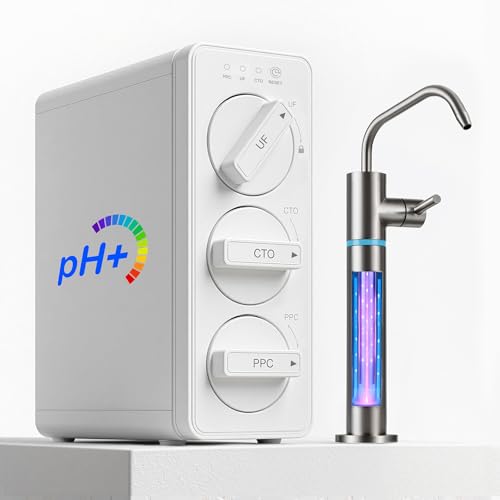
LCF Under Sink UV-C Ultra-Filtration System
Best for: Alkaline water and zero wastewater needs
- Filtration Stages
- 3
- Design
- Under sink
- Filtration Type
- Ultrafiltration, alkaline, UV
- Contaminants Removed
- Chlorine, PFAS, fluoride, heavy metals
- Installation Type
- Under sink
- Features
- LED UV faucet, filter life reminder
View on Amazon: LCF Under Sink UV-C Ultra-Filtration System Affiliate link
This LCF under-sink unit uses 0.01μm ultra-filtration and UV-C light to remove contaminants without wastewater. It adds alkaline minerals to raise pH, meaning it does not lower TDS levels. The system includes a smart LED faucet and a filter life reminder. You get a compact 3-stage design that fits under most sinks. It suits those who want mineral-rich water and zero drain waste.
Pros
- 0.01μm ultra-filtration removes bacteria and heavy metals
- UV-C faucet sterilizes water with LED technology
- Alkaline boost raises pH for mineral-rich water
- No wastewater or drain pipe required
- Built-in filter life reminder tracks maintenance
Cons
- Does not lower TDS levels due to alkaline minerals
- Only 3 filtration stages compared to 5-stage competitors
- UV-C function only activates at flow rates under 2L/min
Good fit if
- You want alkaline water without using a reverse osmosis system
- You need a filter system that produces zero wastewater
- You prefer UV-C sterilization for added bacteria protection
Skip if
- You require TDS reduction for low mineral content
- You need a 5-stage filtration system for maximum purification
- You want a faucet that works at high flow rates with UV
Verdict: LCF 0.01μm Ultra-Filtration UV-C System offers a no-waste, alkaline-rich alternative for buyers who do not need TDS reduction. It fits users prioritizing mineral content and UV sterilization over multi-stage membrane filtration.
Specifications side by side
| Spec | iSpring RCC7-BN 75 GPD Under Sink RO | LCF Under Sink UV-C Ultra-Filtration System |
|---|---|---|
| Filtration Stages | 5 | 3 |
| Capacity (GPD) | 75 | not stated |
| Design | Under sink | Under sink |
| Certification | NSF/ANSI 58 | not stated |
| Filtration Type | Reverse osmosis | Ultrafiltration, alkaline, UV |
| Contaminants Removed | not stated | Chlorine, PFAS, fluoride, heavy metals |
| Installation Type | Under sink | Under sink |
| Features | not stated | LED UV faucet, filter life reminder |
| Micron Rating | 0.0001 | 0.01 μm |
| Capacity | 75 GPD | not stated |
| Use | Drinking Water | not stated |
| Dimensions | 15 × 8 × 18 inches | 12.2 × 4.34 × 11.6 inches |
| Weight | 27.5 pounds | not stated |
| Size | Regular | not stated |
| Color | Brushed Nickel Faucet | not stated |
| Model | RCC7-BN | LCF-UF-ST |
Frequently asked questions
Does the iSpring system produce wastewater?
Yes, the iSpring RCC7-BN is a standard reverse osmosis unit. This technology separates contaminants by pushing water through a semi-permeable membrane. The process generates waste water as part of the purification cycle. It is not designed for zero-waste operation. You should account for this water usage during installation.
Is the LCF system a true reverse osmosis unit?
No, the LCF unit is an ultra-filtration system. It uses a 0.01-micron filter instead of an RO membrane. This method does not remove dissolved solids like TDS. It focuses on physical filtration and UV sterilization. It is suitable if you want to retain minerals in your drinking water.
Which system saves more under-sink space?
The LCF system is more compact. Its dimensions are 12.2 inches in length, 4.34 inches in width, and 11.6 inches in height. The iSpring unit measures 15 inches long, 8 inches wide, and 18 inches tall. If you have a small cabinet, the LCF model fits more easily.
Does the LCF system remove bacteria?
Yes, it includes UV-C filtration. This feature sterilizes water by disrupting microbial DNA. The system does not use a membrane for this step. It relies on ultraviolet light to handle bacteria. This makes it a good choice for users prioritizing biological safety over chemical contaminant reduction.
Can the iSpring system reduce lead and arsenic?
Yes, the iSpring RCC7-BN is NSF Certified for contaminant reduction. Its 5-stage reverse osmosis process targets heavy metals. It removes up to 99% of over 1,000 contaminants. This includes lead and arsenic. It is designed for households needing deep purification of their tap water.
Does the LCF system add minerals to water?
Yes, the LCF system is noted for alkaline water output. Because it uses ultra-filtration rather than reverse osmosis, it does not strip minerals. It retains beneficial elements while filtering particles. This is ideal for users who prefer mineral-rich drinking water over low TDS water.