Oceanic 800 GPD RO/DI System vs Oceanic 600 GPD Commercial RO/DI (2026): Key Differences
As an Amazon Associate we earn from qualifying purchases. Links on this page are affiliate links.
When you compare the oceanic 800 gpd ro di system vs 600 gpd commercial ro di, you see two commercial-grade units built for high-volume pure water production. Both systems use reverse osmosis and deionization to remove 99% of contaminants, delivering 0 TDS water. They both include a built-in booster pump to optimize pressure. The main difference lies in their stated capacity and physical footprint. You need to decide which size fits your space and output needs.
Key differences
| Aspect | Oceanic 800 GPD RO/DI System | Oceanic 600 GPD Commercial RO/DI |
|---|---|---|
| Capacity | 800 GPD | 600 GPD |
| Length | 16 inches | 18 inches |
| Weight | 35 pounds | 65 pounds |
| Width | 12 inches | 12 inches |
| Height | 36 inches | 36 inches |
Which one should you choose?
Choose Oceanic 800 GPD RO/DI System if
- You need a higher daily production capacity of 800 GPD.
- You have limited floor space and need a shorter unit at 16 inches long.
- You prefer a lighter system that weighs only 35 pounds.
Choose Oceanic 600 GPD Commercial RO/DI if
- You require a system explicitly rated for 600 GPD output.
- You can accommodate a longer unit that is 18 inches deep.
- You do not mind the heavier weight of 65 pounds for stable installation.
Verdict: The 800 GPD model offers higher output and a more compact length, making it better for tight spaces needing maximum production. The 600 GPD unit is longer and heavier, which may suit setups where footprint depth is less critical. Choose based on your specific space constraints and daily water volume requirements.
Capacity, Size, and Weight Comparison
Daily production capacity
The Oceanic 800 GPD RO/DI System offers a rated capacity of 800 gallons per day. The Oceanic 600 GPD Commercial RO/DI is rated for 600 gallons per day. Both units fall within the broader 300-800 GPD range listed in their titles, but the specific model names indicate their primary output tiers. If you require higher volume output for larger aquariums or commercial tasks, the 800 GPD model provides a 200-gallon per day advantage. Both systems use reverse osmosis and deionization to achieve 0 TDS water, but the throughput difference is significant for high-demand environments.
Physical footprint
Both systems share the same width of 12 inches and height of 36 inches. However, the Oceanic 800 GPD RO/DI System has a length of 16 inches. The Oceanic 600 GPD Commercial RO/DI is slightly longer at 18 inches. This two-inch difference in depth may affect how you fit the unit into a tight cabinet or utility space. Despite the 800 GPD model being shorter in length, it is lighter. The 600 GPD unit requires more horizontal space but weighs significantly more. Check your available floor space carefully before deciding.
Unit weight
The Oceanic 800 GPD RO/DI System weighs 35 pounds. The Oceanic 600 GPD Commercial RO/DI weighs 65 pounds. This 30-pound difference is substantial. The lighter 800 GPD unit is easier to move, install, or reposition if needed. The heavier 600 GPD unit may require more robust shelving or floor support. Both are commercial-grade systems, but the weight disparity suggests different internal component densities or housing materials. If you need to move the system frequently, the lighter option is more practical.
Filtration technology
Both systems utilize Reverse Osmosis combined with Deionization (RO/DI) filtration. This dual-stage process is designed to remove 99% of contaminants and impurities, resulting in 0 TDS water. Both models include a built-in booster pump to raise water pressure to the optimal level for the reverse osmosis process. There is no difference in the core filtration type or the inclusion of the booster pump. Both are suitable for aquariums, laboratories, and commercial uses requiring ultra-pure water. The filtration performance specification is identical between the two units.
Intended use classification
The Oceanic 800 GPD RO/DI System is classified for light commercial use. The Oceanic 600 GPD Commercial RO/DI is also listed for light commercial use in its attributes. Both are described as commercial-grade systems suitable for aquariums, manufacturing, hotels, and pet shops. Despite the difference in gallon-per-day output, the marketing classification remains the same. You should choose based on your volume needs rather than the use category, as both are designed for high-production environments where standard residential systems would be insufficient.
Which RO/DI system fits your needs?
High-volume commercial operations needing max output
You need the highest daily production rate available. This model offers an 800 GPD capacity, which is the upper limit of the system range. It is the better choice if your facility requires more than 600 gallons of ultra-pure water per day for manufacturing or large-scale aquarium use.
Users with limited floor space
Footprint matters in tight utility rooms. This unit measures 16 inches in length, while the alternative is 18 inches long. Both share the same width and height. The shorter depth helps you fit the system into narrower cabinets or along walls where every inch of clearance counts.
Installers prioritizing portability and handling
Weight affects how easy it is to move during installation. This system weighs 35 pounds, significantly less than the 65-pound alternative. If you need to relocate the unit or install it without heavy machinery, the lighter weight makes handling simpler and reduces strain on your back.
The products compared
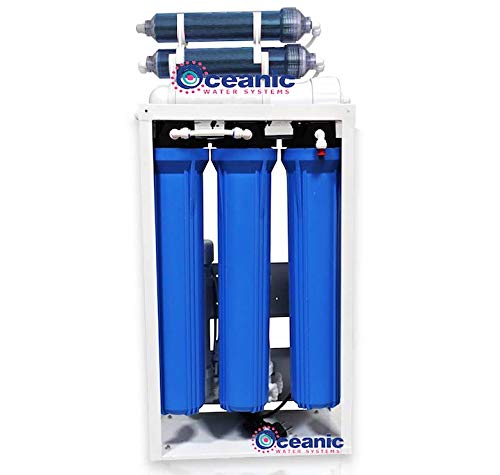
Oceanic 800 GPD RO/DI System
Best for: High-volume commercial or aquarium use
- Capacity (GPD)
- 800 GPD
- Design
- Commercial
- Filtration Type
- Reverse Osmosis + Deionization (RO/DI)
- Contaminants Removed
- 99% contaminants, 0 TDS
- Features
- Booster pump
- Use
- Light Commercial
View on Amazon: Oceanic 800 GPD RO/DI System Affiliate link
This Oceanic unit delivers up to 800 gallons per day of 0 TDS water through a commercial-grade reverse osmosis and deionization process. A built-in booster pump raises input pressure to optimize filtration speed. Measuring 12 by 16 by 36 inches and weighing 35 pounds, it suits light commercial environments or high-demand aquariums needing consistent ultra-pure output.
Pros
- 800 GPD production capacity
- Built-in booster pump for higher pressure
- Removes 99% of contaminants for 0 TDS water
- Commercial-grade RO/DI design
Cons
- Large footprint requires 12 by 16 inch floor space
- Heavy at 35 pounds
- Tall at 36 inches
Good fit if
- You need high-volume pure water for commercial or heavy use
- You require a booster pump to handle low input pressure
- You have space for a large commercial unit
Skip if
- You need a compact under-sink residential system
- You have limited vertical clearance for a 36 inch unit
- You cannot support a 35 pound weight
Verdict: Oceanic 800 GPD Commercial RO/DI System fits buyers who need high-volume pure water and have the space for a large commercial unit.
Oceanic 600 GPD Commercial RO/DI
Best for: Light commercial and high-volume aquarium use
- Capacity (GPD)
- 600 GPD
- Design
- Commercial
- Filtration Type
- Reverse Osmosis + Deionization (RO/DI)
- Contaminants Removed
- 99% contaminants, 0 TDS
- Features
- Booster pump
- Capacity
- 800 GPD
View on Amazon: Oceanic 600 GPD Commercial RO/DI Affiliate link
This Oceanic unit is a light commercial reverse osmosis and deionization system. It delivers up to 800 gallons per day with a built-in booster pump to maintain pressure. The design removes 99% of contaminants for 0 TDS water. It measures 18 by 12 by 36 inches and weighs 65 pounds. You should use this for aquariums, labs, or small commercial settings needing high-volume ultra-pure water.
Pros
- 800 GPD capacity for high-volume output
- Built-in booster pump optimizes water pressure
- Removes 99% of contaminants for 0 TDS water
- Commercial-grade RO/DI filtration design
Cons
- Weighs 65 pounds, requiring sturdy support
- Large footprint at 18 by 12 by 36 inches
- No mention of remote monitoring or app control
Good fit if
- You need high-volume ultra-pure water for aquariums
- You require a light commercial filtration solution
- You want a system with a built-in booster pump
Skip if
- You have limited counter or floor space
- You cannot support a 65-pound unit
- You need a compact residential under-sink system
Verdict: Oceanic 800 GPD RO/DI System fits users who need reliable, high-volume pure water for commercial or heavy hobbyist use. It is not suitable for small residential kitchens with limited space.
Specifications side by side
| Spec | Oceanic 800 GPD RO/DI System | Oceanic 600 GPD Commercial RO/DI |
|---|---|---|
| Capacity (GPD) | 800 GPD | 600 GPD |
| Design | Commercial | Commercial |
| Filtration Type | Reverse Osmosis + Deionization (RO/DI) | Reverse Osmosis + Deionization (RO/DI) |
| Contaminants Removed | 99% contaminants, 0 TDS | 99% contaminants, 0 TDS |
| Features | Booster pump | Booster pump |
| Capacity | 800 GPD | 800 GPD |
| Use | Light Commercial | Light Commercial |
| Dimensions | 16 × 12 × 36 inches | 18 × 12 × 36 inches |
| Weight | 35 pounds | 65 pounds |
| Size | 800 GPD | 600 GPD |
Frequently asked questions
Which system is smaller in footprint?
The Oceanic 800 GPD RO/DI System has a slightly smaller footprint. It measures 16 inches in length and 12 inches in width. The 600 GPD model is 18 inches long with the same width. If your installation space is tight, the 800 GPD unit saves two inches of depth.
Which unit weighs less?
The Oceanic 800 GPD RO/DI System is lighter. It weighs 35 pounds. The 600 GPD Commercial RO/DI weighs 65 pounds. The difference is 30 pounds. You will find the 800 GPD model easier to move or reposition during installation or maintenance.
Do both systems include a booster pump?
Yes, both systems include a booster pump. This feature is listed in the attributes for each unit. A booster pump helps maintain consistent pressure for optimal filtration performance. You get this component with either the 800 GPD or 600 GPD model.
Do both systems use deionization?
Yes, both systems use deionization. This feature is listed in the attributes for each unit. Deionization removes remaining ions after reverse osmosis to achieve high purity. You get this stage with either the 800 GPD or 600 GPD model.
Which system is better for high-volume commercial use?
The Oceanic 800 GPD RO/DI System is rated for high-volume commercial use. It produces 800 gallons per day. The 600 GPD model is rated for light commercial use. If your daily water demand is near the maximum capacity, the 800 GPD unit is the stronger choice.
Are the heights of the two systems the same?
Yes, the heights are identical. Both the Oceanic 800 GPD and 600 GPD systems stand 36 inches tall. This standard height makes them compatible with similar mounting setups. You only need to check the length and weight differences for your specific space.