Waterdrop or Glacier Fresh? Reverse Osmosis Systems Compared in 2026
As an Amazon Associate we earn from qualifying purchases. Links on this page are affiliate links.
You are comparing the waterdrop vs glacier fresh reverse osmosis system to find the best fit for your kitchen. Both units are tankless under-sink filters that save space and offer fast flow rates. The main difference lies in their power needs and filtration depth. Waterdrop uses electricity for a smart display and eight stages, while Glacier Fresh is electric-free with five stages. Choose the model that matches your water quality and installation constraints.
Key differences
| Aspect | Waterdrop G3P600 600 GPD Tankless RO | Glacier Fresh 800 GPD Tankless RO |
|---|---|---|
| Capacity | 600 GPD | 800 GPD |
| Design | Tankless (requires electricity) | Tankless (electric-free) |
| Filtration Stages | 8-stage | 5-stage |
| Pure to Drain Ratio | 2:1 | 3:1 |
| Certification | NSF/ANSI 58, 372, 42 | NSF/ANSI 58, 372, 401 |
| Special Features | Smart display faucet with TDS monitor | Built-in real-time pressure gauge |
Which one should you choose?
Choose Waterdrop G3P600 600 GPD Tankless RO if
- You want a smart faucet that displays TDS levels and filter life.
- You prefer an 8-stage filtration process for broader contaminant removal.
- You have access to an under-sink electrical outlet.
Choose Glacier Fresh 800 GPD Tankless RO if
- You need a system that operates without electricity.
- You want a higher production rate of 800 GPD.
- You prioritize a more water-efficient 3:1 drain ratio.
Verdict: The Waterdrop G3P600 suits you if you value advanced monitoring and deeper filtration stages. The Glacier Fresh GFU03 is better for installations without power and those seeking higher daily output with less wastewater. Your choice depends on your electrical access and specific water quality needs.
Waterdrop vs Glacier Fresh RO
filtration stages
Waterdrop uses an 8-stage filtration process, while Glacier Fresh relies on a 5-stage system. More stages often mean more pre-filtration to protect the main membrane, potentially extending its life. Waterdrop’s extra stages target specific contaminants like vinyl chloride and ethylhexyl acrylate, which are not explicitly listed in Glacier Fresh’s reduction claims. Glacier Fresh focuses on a high-precision 0.0001μm membrane to intercept ultra-fine impurities. Both systems aim for clean water, but Waterdrop offers a broader multi-layer approach to remove particles, chlorine, and heavy metals before the final reverse osmosis step. You get more layers of defense with the Waterdrop model.
water efficiency
Water efficiency matters for your utility bills and environmental impact. Glacier Fresh boasts a 3:1 pure-to-drain ratio, meaning it produces three cups of clean water for every one cup of waste. Waterdrop offers a 2:1 ratio, producing two cups of pure water for every cup of waste. Both ratios are significantly better than older systems that waste large amounts of water. Glacier Fresh is the more efficient choice here, saving you more water during the filtration process. If minimizing wastewater is a priority for your home, the Glacier Fresh unit has the clear advantage in this category.
power requirements
Power needs change your installation options. Waterdrop requires under-sink electricity to operate its smart display faucet and pump. This means you need an outlet near the sink. Glacier Fresh is an electric-free system. It uses a water-powered structure, so you do not need any external power source. This eliminates electricity-related safety risks and makes installation easier in cabinets without outlets. You also avoid operating noise from electric pumps with the Glacier Fresh model. If you lack an under-sink outlet or want a silent unit, Glacier Fresh is the better fit.
certifications
Both systems hold important NSF certifications for safety and performance. Waterdrop is certified against NSF/ANSI 58 for TDS reduction, NSF/ANSI 372 for lead-free materials, and NSF 42 for chlorine and taste reduction. Glacier Fresh meets NSF/ANSI 58, 372, and 401 standards. The key difference is the NSF 401 certification for Glacier Fresh. This standard covers the removal of emerging contaminants like pharmaceuticals and environmental pollutants, which are not covered by the NSF 42 standard Waterdrop holds. While Waterdrop has FCC and EU certifications, Glacier Fresh’s NSF 401 offers broader contaminant coverage for drinking water safety.
design and size
Both units are tankless and save space, but their dimensions differ. Waterdrop measures 18.1 inches long, 5.68 inches wide, and 17.8 inches high. It weighs 31 pounds. Glacier Fresh is more compact, measuring 13.6 inches long, 8.27 inches wide, and 16.5 inches high. It does not list a weight. Glacier Fresh’s smaller footprint may fit better in tighter under-sink cabinets. Waterdrop is longer but narrower. Both claim to save 70% of space compared to tank systems. If you have a narrow but deep cabinet, Waterdrop might fit better. For a wider, shallower space, Glacier Fresh is likely the superior choice.
Which RO system fits your needs
Homeowners needing no electricity
The Glacier Fresh GFU03 operates without external power, using a water-powered structure. This eliminates electricity-related safety risks and ensures zero operating noise. It fits most under-sink environments where power access is limited or unavailable, making it a safe and quiet choice for your kitchen.
Users wanting water quality monitoring
The Waterdrop G3P600 includes a smart display faucet with a TDS monitor. This lets you see the quality of your filtered water in real time. It also features a filter life tracker to remind you when replacements are needed. This visual feedback helps you maintain optimal water purity easily.
Buyers prioritizing water efficiency
Glacier Fresh offers a 3:1 pure-to-drain ratio, producing one cup of waste water for every three cups of purified water. This outperforms the Waterdrop’s 2:1 ratio. If reducing water waste is a priority, this higher efficiency makes the Glacier Fresh system a more sustainable option for your household.
Shoppers seeking broader certifications
Waterdrop holds NSF/ANSI 58, 372, and 42 certifications, plus EU and UKCA safety standards. While Glacier Fresh meets NSF 58, 372, and 401, Waterdrop’s additional NSF 42 certification specifically addresses chlorine, taste, and odor reduction. This broader certification portfolio may provide extra assurance regarding material safety and contaminant removal.
The products compared

Waterdrop G3P600 600 GPD Tankless RO
Best for: Space-constrained kitchens needing high flow
- Filtration Stages
- 8
- Capacity (GPD)
- 600 GPD
- Design
- Tankless
- Pure to Drain Ratio
- 2:1
- Certification
- NSF/ANSI 42, 53, 58, 372
- Filtration Type
- Reverse osmosis
View on Amazon: Waterdrop G3P600 600 GPD Tankless RO Affiliate link
The Waterdrop G3P600 is a tankless reverse osmosis system with a 600 GPD capacity. It features an 8-stage filtration process and holds NSF/ANSI 58 certification for TDS reduction. The unit includes a smart display faucet showing TDS levels and filter life. Its compact design saves under-sink space, measuring 18.1 inches long. This system suits households needing high daily output without a storage tank.
Pros
- 600 GPD tankless capacity
- NSF/ANSI 58 certified
- Smart display faucet with TDS monitor
- 2:1 pure to drain ratio
Cons
- Requires under-sink electricity
- No storage tank for backup supply
- Heavier build at 31 pounds
Good fit if
- You need a high-capacity system for daily use
- You want to save under-sink space
- You prefer real-time water quality monitoring
Skip if
- You cannot install under-sink electricity
- You need a gravity-fed or electric-free unit
- You require a large storage tank
Verdict: Waterdrop G3P600 Tankless RO System fits users who prioritize space savings and high flow rates over stored water capacity. It is ideal for kitchens where electricity is available under the sink.
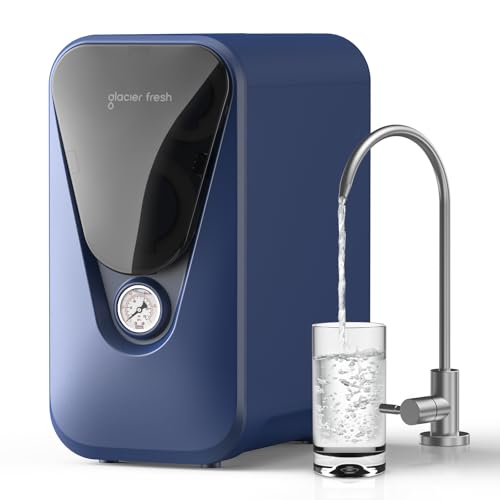
Glacier Fresh 800 GPD Tankless RO
Best for: High-flow needs without electricity or tanks
- Filtration Stages
- 7
- Capacity (GPD)
- 800 GPD
- Design
- Tankless, under sink
- Pure to Drain Ratio
- 3:1
- Certification
- NSF/ANSI 58, 372, 401
- Filtration Type
- Reverse osmosis
View on Amazon: Glacier Fresh 800 GPD Tankless RO Affiliate link
The Glacier Fresh GFU03 is a tankless reverse osmosis system with an 800 GPD capacity. It uses a non-electric, water-powered design that saves under-sink space and eliminates noise. The 5-stage filtration meets NSF/ANSI 58, 372, and 401 standards. It features a 3:1 pure-to-drain ratio and a 0.0001 μm membrane. This unit suits large families needing fast flow without external tanks.
Pros
- 800 GPD capacity delivers water in 8 seconds
- Non-electric design saves space and reduces noise
- 3:1 pure-to-drain water ratio minimizes waste
- Meets NSF/ANSI 58, 372, and 401 certifications
Cons
- Requires a minimum inlet pressure of 40 PSI for proper flow
- Needs a 1/2 to 1 inch hole drilled in the sink
- Initial rinse of filters takes 10 to 20 minutes
Good fit if
- You need high daily water volume for a large household
- You want to save under-sink cabinet space
- You prefer a system with no electricity requirement
Skip if
- Your water pressure is consistently below 40 PSI
- You cannot drill a hole in your sink or countertop
- You require an electric booster pump for high flow
Verdict: Glacier Fresh GFU03 800 GPD Tankless RO fits homes with strong water pressure and tight under-sink spaces. It provides high-capacity purified water without the bulk of a storage tank.
Specifications side by side
| Spec | Waterdrop G3P600 600 GPD Tankless RO | Glacier Fresh 800 GPD Tankless RO |
|---|---|---|
| Filtration Stages | 8 | 7 |
| Capacity (GPD) | 600 GPD | 800 GPD |
| Design | Tankless | Tankless, under sink |
| Pure to Drain Ratio | 2:1 | 3:1 |
| Certification | NSF/ANSI 42, 53, 58, 372 | NSF/ANSI 58, 372, 401 |
| Filtration Type | Reverse osmosis | Reverse osmosis |
| Contaminants Removed | TDS, chromium, PFAS, radium, fluoride | PFAS, lead, TDS, PFOA, PFOS, chlorine |
| Installation Type | Under-sink | Under sink |
| Features | Smart display faucet, TDS monitor | Water pressure gauge, non-electric |
| Micron Rating | not stated | 0.0001 μm |
| Capacity | not stated | 800 GPD |
| Color | White | Deep Blue-RO Filtration |
| Dimensions | 18.1 × 5.68 × 17.8 inches | 13.6 × 8.27 × 16.5 inches |
| Weight | 31 pounds | not stated |
| Size | 600 GPD | U03-Classic |
| Model | WD-G3 | GFU03 |
Frequently asked questions
Which RO system is smaller under the sink?
The Waterdrop G3P600 has a slightly larger footprint in width and length. It measures 18.1 inches long and 5.68 inches wide. The Glacier Fresh GFU03 is deeper but narrower. It measures 13.6 inches long and 8.27 inches wide. You should measure your specific cabinet space before choosing.
Does the Waterdrop G3P600 require electricity?
Yes, the Waterdrop G3P600 requires an electrical outlet under your sink. It is a tankless system that uses power to push water through the membrane. This allows it to maintain high flow rates without a storage tank. Ensure you have a nearby power source before installation.
What is the daily production capacity of these units?
The Waterdrop G3P600 produces 600 gallons per day. The Glacier Fresh GFU03 produces 800 gallons per day. Both ratings indicate how much purified water they can generate in 24 hours. Higher GPD ratings generally support larger households or higher usage volumes.
How heavy are these reverse osmosis systems?
The Waterdrop G3P600 weighs 31 pounds. The Glacier Fresh GFU03 weight is not specified in the data. The Waterdrop unit is a substantial piece of equipment. You should ensure your cabinet shelf can support the weight of the unit plus water.
Which system is better for tight spaces?
The Glacier Fresh GFU03 is designed for tight under-sink spaces. Its compact dimensions help it fit in narrower cabinets. The Waterdrop G3P600 is also tankless but has different dimensions. Check your cabinet width and depth to see which shape fits your layout better.
Do these units come with storage tanks?
No, both the Waterdrop G3P600 and the Glacier Fresh GFU03 are tankless. They produce water on demand rather than storing it in a large pressure vessel. This design saves significant under-sink space. You get fresh water directly from the faucet when you turn it on.