800 GPD vs 75 GPD Reverse Osmosis Systems: Which Should You Buy?
As an Amazon Associate we earn from qualifying purchases. Links on this page are affiliate links.
Choosing between an 800 GPD vs 75 GPD reverse osmosis system depends on your household water usage. Both units provide under-sink installation and remove contaminants for drinking water. The primary difference lies in their production capacity. One model delivers a high flow rate for large families, while the other offers a traditional setup with a storage tank. You should review the specific filtration stages and design features to determine which system fits your kitchen space and daily needs.
Key differences
| Aspect | Waterdrop G3P800 Tankless RO System | iSpring RCC7-BN 75 GPD Under Sink RO |
|---|---|---|
| Capacity (GPD) | 800 | 75 |
| Filtration Stages | 10 | 5 |
| Design | Tankless | With storage tank |
| Certification | NSF/ANSI 42, 53, 58, 372 | NSF/ANSI 58 |
| Pure to Drain Ratio | 3:1 | not listed |
| Features | Smart faucet, TDS display | Standard faucet |
Which one should you choose?
Choose Waterdrop G3P800 Tankless RO System if
- You need a high flow rate to fill glasses quickly without waiting.
- You want to save under-sink space with a tankless design.
- You prefer a system with multiple certifications for lead-free materials and taste.
Choose iSpring RCC7-BN 75 GPD Under Sink RO if
- You have a smaller household with lower daily water demands.
- You prefer a traditional system with a storage tank for consistent pressure.
- You want a proven design with a long history of customer satisfaction.
Verdict: The Waterdrop G3P800 suits larger families who need fast water flow and space-saving tankless design. The iSpring RCC7-BN is a better fit for smaller households that prefer a traditional setup with a storage tank. Both systems effectively reduce contaminants for safe drinking water.
800 GPD vs 75 GPD RO Systems
Daily production capacity
The Waterdrop G3P800 delivers 800 gallons per day, while the iSpring RCC7-BN produces 75 gallons per day. This massive difference affects how quickly you can fill large containers. The Waterdrop unit filters one cup of water in just five seconds. This high flow rate supports big families or homes with high water demands. The iSpring system is slower, which may require waiting for a full pitcher. If you need immediate, high-volume water for cooking or filling tanks, the 800 GPD model is the clear choice. The 75 GPD unit suits smaller households with modest daily needs.
Filtration stages
The Waterdrop G3P800 uses a 10-stage filtration process. The iSpring RCC7-BN relies on a 5-stage system. More stages often mean more layers of protection against specific contaminants. The Waterdrop system is tested to reduce PFAS, fluoride, heavy metals, and radioactive substances. It also targets specific industrial chemicals like vinyl chloride. The iSpring system removes over 1,000 contaminants and reduces TDS by 80-90%. Both provide safe drinking water. However, the Waterdrop offers a more complex filtration path. This may appeal to users seeking detailed contaminant reduction beyond basic purification.
Certifications
Certifications verify that a system meets strict safety and performance standards. The Waterdrop G3P800 holds four key certifications: NSF/ANSI 42, 53, 58, and 372. These cover taste, odor, contaminant reduction, and lead-free materials. The iSpring RCC7-BN is certified to NSF/ANSI 58 for contaminant reduction. While both meet essential standards, the Waterdrop provides broader verification. The additional NSF 42 and 53 certifications confirm improvements in taste and chlorine removal. The NSF 372 certification ensures no lead leaching from materials. The iSpring system meets the core requirement for safe water but lacks the extra layered certifications found in the Waterdrop.
Water efficiency
Water efficiency is measured by the pure to drain ratio. The Waterdrop G3P800 has a 3:1 ratio. This means it produces three cups of clean water for every one cup of wastewater. The iSpring RCC7-BN does not list a specific pure to drain ratio in its published specifications. Without this data, you cannot compare the efficiency directly. However, a 3:1 ratio is considered modern and efficient for tankless systems. If water conservation is a priority, the Waterdrop’s stated ratio is a clear advantage. You can estimate the iSpring’s efficiency, but the lack of a published spec makes direct comparison difficult.
Design and features
The Waterdrop G3P800 features a tankless design that saves under-sink space. It includes a smart faucet with an LED display showing TDS levels. The LED indicator turns on automatically when water flows. The iSpring RCC7-BN uses a traditional tank design, which takes up more space. It includes a transparent first-stage housing for easy filter inspection. The iSpring faucet is lead-free but lacks digital monitoring. The Waterdrop’s tankless form factor is more compact. The smart faucet provides real-time water quality data. The iSpring offers simplicity and visual access to filters. The choice depends on whether you prefer smart technology or manual inspection.
Physical footprint
Size matters for under-sink installation. The Waterdrop G3P800 is compact, measuring 18.1 inches long, 5.67 inches wide, and 17.7 inches high. It weighs only 1.76 pounds. The iSpring RCC7-BN is larger and heavier. It measures 15 inches long, 8 inches wide, and 18 inches high. It weighs 27.5 pounds. The iSpring’s weight likely includes a storage tank, which adds bulk. The Waterdrop’s tankless unit is significantly lighter and narrower. If you have limited cabinet space, the Waterdrop fits more easily. The iSpring requires more room due to its traditional design and heavier components.
Which RO system fits your needs
Large households needing high daily output
The Waterdrop G3P800 produces 800 gallons per day. This high capacity ensures you have plenty of filtered water for a big family. It filters one cup in just five seconds. The tankless design saves space under your sink. You get consistent flow without waiting for a tank to refill.
Budget-conscious buyers wanting simple reliability
The iSpring RCC7-BN offers 75 gallons per day. This capacity suits smaller households or those who do not need constant high flow. It features a five-stage filtration system. The design is compact and fits under most kitchen sinks. You get straightforward operation without complex electronics or smart faucets.
Users wanting real-time water quality data
The Waterdrop G3P800 includes a smart faucet with a TDS display. You can check water quality at a glance. The LED indicator turns on automatically when water flows. This feature provides immediate feedback on filtration performance. The iSpring model lacks this digital monitoring capability in its standard configuration.
Buyers prioritizing certified material safety
The Waterdrop G3P800 holds NSF/ANSI 372 certification for lead-free materials. It also carries certifications for chlorine reduction and TDS removal. The iSpring unit is certified for TDS reduction. The Waterdrop system provides additional assurance regarding the safety of the materials in contact with your drinking water.
Quick picks
| # | Product | Best for | Price |
|---|---|---|---|
| 1 | Waterdrop G3P800 Tankless RO System | High-flow households wanting certified tankless filtration | Check price of Waterdrop G3P800 Tankless RO System on Amazon |
| 2 | iSpring RCC7-BN 75 GPD Under Sink RO | Standard households prioritizing certified safety | Check price of iSpring RCC7-BN 75 GPD Under Sink RO on Amazon |
The products compared
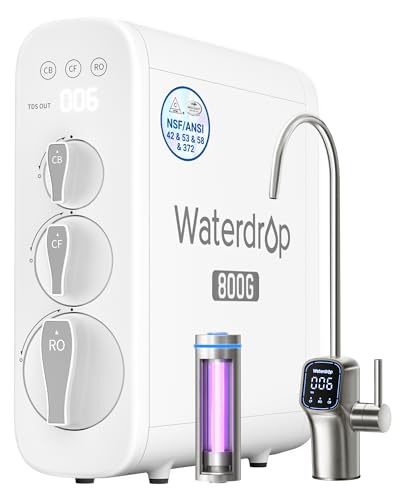
Waterdrop G3P800 Tankless RO System
Best for: High-flow households wanting certified tankless filtration
- Capacity
- 800 GPD (what this guide is about)
- Filtration Stages
- 10
- Capacity (GPD)
- 800
- Design
- Tankless, under sink
- Pure to Drain Ratio
- 3:1
- Certification
- NSF 42, NSF 53, NSF 58, NSF 372
View on Amazon: Waterdrop G3P800 Tankless RO System Affiliate link
The Waterdrop G3P800 is an under-sink reverse osmosis system with an 800 GPD capacity. It uses a 10-stage filtration process and holds NSF/ANSI 42, 53, 58, and 372 certifications. The unit features a tankless design that saves space and includes a smart faucet with TDS display. It delivers water quickly with a 3:1 pure to drain ratio, making it suitable for households needing high-volume purified water.
Pros
- 800 GPD high capacity for large families
- NSF/ANSI 42, 53, 58, and 372 certified
- 10-stage filtration reduces PFAS and heavy metals
- Tankless design saves under-sink space
- Smart faucet includes TDS level display
Cons
- Requires under-sink installation space
- 3:1 pure to drain ratio produces wastewater
- No mention of mobile app connectivity
Good fit if
- You need high daily water output
- You want NSF certifications for safety
- You prefer a tankless design
Skip if
- You have limited under-sink space
- You want a built-in water tank
- You need app-based monitoring
Verdict: Waterdrop G3P800 Tankless RO System fits buyers who prioritize high flow rates and certified filtration in a compact, tankless unit. It suits those who value real-time water quality data from the faucet.

iSpring RCC7-BN 75 GPD Under Sink RO
Best for: Standard households prioritizing certified safety
- Capacity
- 75 GPD (what this guide is about)
- Filtration Stages
- 5
- Capacity (GPD)
- 75
- Design
- Under sink
- Certification
- NSF/ANSI 58
- Filtration Type
- Reverse osmosis
View on Amazon: iSpring RCC7-BN 75 GPD Under Sink RO Affiliate link
This iSpring under-sink system produces 75 gallons per day using five filtration stages. It carries NSF/ANSI 58 certification and reduces contaminants down to 0.0001 microns. The unit measures 8 by 15 by 18 inches and weighs 27.5 pounds. It includes a lead-free faucet and requires no power source. This setup suits households with moderate daily water needs who prioritize certified safety and compact installation under the sink.
Pros
- NSF/ANSI 58 certified for quality standards
- Removes up to 99% of over 1,000 contaminants
- Compact dimensions fit under most kitchen sinks
- No power source required for operation
Cons
- 75 GPD capacity is lower than 800 GPD models
- Includes a storage tank not mentioned in specs
- Requires 18 inches of vertical clearance
Good fit if
- You need certified contaminant reduction under the sink
- You have limited counter space for a faucet
- You want a system that requires no electricity
Skip if
- You need high daily output for large families
- You prefer a tankless design for instant flow
- You want a system with a digital display
Verdict: iSpring RCC7-BN 75 GPD RO System offers certified safety and a compact footprint for standard households. It fits buyers who value proven filtration standards over high-volume speed.
Specifications side by side
| Spec | Waterdrop G3P800 Tankless RO System | iSpring RCC7-BN 75 GPD Under Sink RO |
|---|---|---|
| Filtration Stages | 10 | 5 |
| Capacity (GPD) | 800 | 75 |
| Design | Tankless, under sink | Under sink |
| Pure to Drain Ratio | 3:1 | not stated |
| Certification | NSF 42, NSF 53, NSF 58, NSF 372 | NSF/ANSI 58 |
| Filtration Type | Reverse osmosis | Reverse osmosis |
| Contaminants Removed | PFAS, fluoride, lead, chromium, iron | not stated |
| Installation Type | Under sink | Under sink |
| Features | Smart faucet, LED function | not stated |
| Micron Rating | not stated | 0.0001 |
| Capacity | 800 GPD | 75 GPD |
| Use | not stated | Drinking Water |
| Color | White | Brushed Nickel Faucet |
| Dimensions | 18.1 × 5.67 × 17.7 inches | 15 × 8 × 18 inches |
| Weight | 33.7 pounds | 27.5 pounds |
| Size | 800 GPD | Regular |
| Model | WD-G3P800-W | RCC7-BN |
Frequently asked questions
Is 800 GPD too much water for a small family?
An 800 GPD system like the Waterdrop G3P800 is not too much for a small family. It operates as a tankless unit, so it does not store excess water in a bulky tank. This design saves under-sink space while still providing immediate high-flow water when you need it.
Do I need a storage tank with an 800 GPD system?
You do not need a storage tank with the Waterdrop G3P800. Its tankless design filters water on demand, eliminating the need for large pressure tanks. This allows for a more compact installation under your sink, with the unit measuring just 18.1 inches in length.
Which system is better for people who value certified filtration?
The iSpring RCC7-BN is better if you prioritize certified safety. It is NSF Certified, ensuring it meets strict standards for contaminant reduction. This makes it a reliable choice for standard households that want proven filtration performance rather than just high-volume speed.
How much space does the Waterdrop G3P800 take up?
The Waterdrop G3P800 takes up minimal space. Its compact tankless design measures 5.67 inches wide and 17.7 inches high. It weighs only 1.76 pounds, making it much lighter and smaller than traditional systems that require large storage tanks and more cabinet room.
Can the iSpring RCC7-BN handle high daily water usage?
The iSpring RCC7-BN produces 75 gallons per day. This capacity suits standard households with moderate drinking and cooking needs. It is not designed for high-volume usage, so large families or those who fill many containers daily might find the flow rate slower than an 800 GPD model.
What is the difference in faucet finish between these models?
The iSpring RCC7-BN comes with a brushed nickel faucet, which offers a specific aesthetic for your kitchen sink. The Waterdrop G3P800 is described in white, focusing on a clean, modern look. Your choice may depend on whether you prefer brushed nickel or a white finish.
Which RO system is lighter and easier to install?
The Waterdrop G3P800 is significantly lighter, weighing only 1.76 pounds. In contrast, the iSpring RCC7-BN weighs 27.5 pounds due to its tank and components. The lighter weight of the Waterdrop unit may simplify handling during installation and reduce stress on your under-sink cabinetry.