Capacity in Reverse Osmosis Systems: What It Is and Is It Worth It?
As an Amazon Associate we earn from qualifying purchases. Links on this page are affiliate links.
Understanding RO System Capacity Specs
Capacity defines how much water a system produces or treats. You see this number on every listing. It sets the limit for daily output or total filtration. Knowing this helps you pick a unit that matches your household needs. The primary keyword for this topic is capacity explained.
Most residential reverse osmosis systems list gallons per day, or GPD. Common values include 50 GPD, 75 GPD, 100 GPD, 600 GPD, and 800 GPD. This number tells you the maximum fresh water made in twenty-four hours. A 50 GPD unit makes about two gallons an hour. An 800 GPD unit makes over thirty gallons an hour. Higher GPD means less waiting time for a full glass.
Some commercial or whole-house units use gallons per minute, or GPM. You might see 12 GPM on large filters. This measures flow speed, not total storage. It matters if you run multiple taps at once. It ensures steady pressure during heavy use.
Water softeners use a different metric: grains. You may see 48,000 grains. This measures total hardness removal before regeneration. It indicates how long the system works before it needs salt or cleaning. Higher grains mean longer intervals between maintenance cycles.
Why does this matter to you? If you have a large family, a low GPD system might leave you waiting. A small system cannot keep up with high demand. You might run out of filtered water during dinner prep. Choosing a higher capacity unit prevents this bottleneck.
For single users, a smaller system saves space and energy. You do not need excess production if you drink little water. Match the spec to your actual usage. Check the label carefully. Ensure the number aligns with your daily routine. This simple check avoids future frustration.
Capacity specs for RO systems
800 GPD
This rating indicates a daily production limit of 800 gallons. You get high flow rates from tankless models like the Waterdrop G3P800. The system produces water fast enough to fill a glass in seconds. It suits large households with heavy water usage. The trade-off is higher energy use for the booster pump. You also need space for the compact unit. This option removes the need for a storage tank. It saves cabinet space but requires a power outlet.
600 GPD
A 600 GPD capacity offers strong performance for most families. The Waterdrop G3P600 delivers rapid flow without a tank. You get filtered water on demand for cooking and drinking. This level handles multiple taps if used sequentially. It fits homes that need more than standard output. The main trade-off is the need for electricity. You must have an outlet under the sink. The system is slightly larger than smaller units. It balances speed and efficiency for daily kitchen tasks.
75 GPD
This is a standard capacity for under-sink systems. The iSpring RCC7-BN fits this category. It produces water slowly, so you need a storage tank. The tank holds purified water for immediate use. This suits small to medium households with moderate usage. You wait for the tank to refill after heavy use. The trade-off is the space taken by the tank. You gain reliability and lower energy costs. It is a practical choice for standard family needs. You do not need a power outlet for operation.
100 GPD
This capacity sits between standard and high-flow options. The iSpring RCC1UP-AK provides 100 GPD with UV protection. You get faster refill rates than 75 GPD units. It suits homes needing extra water volume. The UV feature adds microbial safety. You need space for the system and power access. The trade-off is complexity and size. You get better protection but higher maintenance. This option is ideal for those wanting more flow than basic models. It handles larger families better than lower capacity units.
50 GPD
A 50 GPD rating is common for basic systems. The APEC ROES-50 uses this capacity. It produces water slowly, relying on a storage tank. This suits small households or single users. You have steady access to filtered water. The trade-off is slower replenishment after heavy use. The system is compact and energy efficient. You do not need electricity for the filtration process. It is a cost-effective entry point. You trade speed for simplicity and lower footprint. It works well for drinking and cooking only.
Is High Capacity Worth The Cost
Who needs it
You need high capacity if your household uses more than two hundred gallons of drinking water daily. Large families with five or more members often require this volume for cooking, drinking, and ice making. If you frequently entertain guests or run a home office with high beverage consumption, a lower capacity system will leave you waiting. Tankless models with rates like 800 GPD provide immediate flow, filling pitchers and glasses in seconds without tank storage. Commercial kitchens or small businesses also benefit from these high-output systems. If you value convenience and never want to wait for water to filter, prioritize the highest GPD rating your plumbing can support. This spec ensures you never run dry during peak usage times.
Who can skip it
You can skip high capacity specs if you live alone or as a couple. Most single-person households use less than fifty gallons of filtered water per day. A standard 75 GPD system easily handles this load. You do not need a 800 GPD unit if you have ample counter space for a storage tank. Smaller systems are often more compact and easier to install under standard sinks. Focus on total dissolved solids removal or specific contaminant filtration instead of flow rate. If you drink filtered water slowly throughout the day, a lower capacity unit performs just as well. Prioritize filter life and maintenance costs over speed. High capacity units often have higher upfront costs and larger physical footprints that may not fit your available space.
RO Capacity Glossary Terms
Gallons Per Day
The maximum volume of purified water the system produces in twenty-four hours. This rating sets the daily limit for your household supply needs.
Storage Tank
A pressurized vessel that holds treated water for immediate use. This allows the RO membrane to work slowly while you get fast flow from the faucet.
Tankless Design
A system without a storage tank that produces water on demand. This saves under-sink space but requires a higher capacity membrane for quick filling.
Pure to Drain Ratio
The amount of clean water produced for every gallon sent to the drain. A higher ratio means the system wastes less water during the filtration process.
Filtration Stages
The number of distinct filters used to remove contaminants. More stages usually mean better removal of specific impurities like lead or fluoride from your water.
Installation Type
How the system connects to your plumbing. Under-sink units are common, while countertop models plug into existing faucets without permanent modification to your kitchen.
Certification
Third-party verification that the system meets safety standards. Look for NSF or WQA marks to ensure the unit actually removes the contaminants it claims to.
Flow Rate
How quickly water comes out of your faucet. High capacity systems provide faster flow rates, reducing the wait time for a full glass of water.
Quick picks
| # | Product | Best for | Price |
|---|---|---|---|
| 1 | Waterdrop G3P800 Tankless RO System | Large households needing high flow rates | Check price of Waterdrop G3P800 Tankless RO System on Amazon |
| 2 | Waterdrop G3P600 600 GPD Tankless RO | High-flow tankless under-sink filtration | Check price of Waterdrop G3P600 600 GPD Tankless RO on Amazon |
| 3 | iSpring RCC7-BN 75 GPD Under Sink RO | Standard households needing certified under-sink filtration | Check price of iSpring RCC7-BN 75 GPD Under Sink RO on Amazon |
| 4 | iSpring RCC1UP-AK 7-Stage RO with UV | homes needing UV protection and 100 GPD flow | Check price of iSpring RCC1UP-AK 7-Stage RO with UV on Amazon |
| 5 | APEC ROES-50 5-Stage Under Sink RO | small households with tank space | Check price of APEC ROES-50 5-Stage Under Sink RO on Amazon |
| 6 | iSpring UVF20 Whole House UV System | whole house microbial disinfection | Check price of iSpring UVF20 Whole House UV System on Amazon |
Our 6 picks
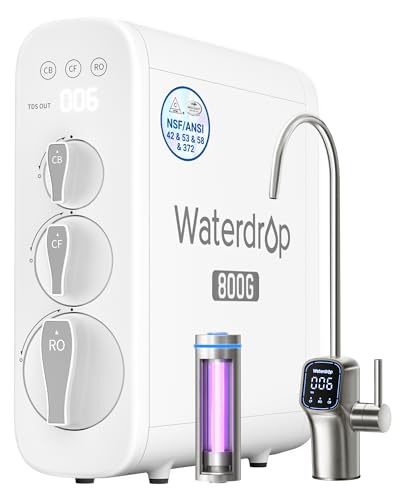
Waterdrop G3P800 Tankless RO System
Best for: Large households needing high flow rates
- Capacity
- 800 GPD (what this guide is about)
- Filtration Stages
- 10
- Capacity (GPD)
- 800
- Design
- Tankless, under sink
- Pure to Drain Ratio
- 3:1
- Certification
- NSF 42, NSF 53, NSF 58, NSF 372
View on Amazon: Waterdrop G3P800 Tankless RO System Affiliate link
The Waterdrop G3P800 is an under-sink reverse osmosis system with an 800 gallons per day capacity. It uses a 10-stage filtration process and holds NSF/ANSI 42, 53, 58, and 372 certifications. The tankless design saves space and includes a smart faucet with a TDS display. This unit suits larger households needing high flow rates without a storage tank.
Pros
- 800 GPD high capacity for big families
- NSF/ANSI 42, 53, 58, and 372 certified
- 10-stage filtration reduces PFAS and heavy metals
- Smart faucet displays TDS levels
- Tankless design saves under-sink space
Cons
- Requires significant under-sink space for the unit
- No built-in water storage tank
- Faucet relies on battery-powered LED
Good fit if
- You need high daily water output
- You want certified contaminant reduction
- You prefer tankless under-sink designs
Skip if
- You have limited under-sink space
- You prefer a system with a storage tank
- You need whole-house filtration
Verdict: Waterdrop G3P800 800 GPD Tankless RO is ideal for large households that need fast, filtered water without the bulk of a storage tank. Its certified filtration and smart faucet make it a practical choice for high-demand kitchens.

Waterdrop G3P600 600 GPD Tankless RO
Best for: High-flow tankless under-sink filtration
- Filtration Stages
- 8
- Capacity (GPD)
- 600 GPD
- Design
- Tankless
- Pure to Drain Ratio
- 2:1
- Certification
- NSF/ANSI 42, 53, 58, 372
- Filtration Type
- Reverse osmosis
View on Amazon: Waterdrop G3P600 600 GPD Tankless RO Affiliate link
The Waterdrop G3P600 is a tankless reverse osmosis system rated at 600 gallons per day. It uses an 8-stage filtration process and holds NSF/ANSI 58 certification for TDS reduction. The unit features a smart display faucet that tracks filter life and water quality. Its compact design saves under-sink space, and it operates with a 2:1 pure-to-drain ratio. You should consider this system if you need high daily output without the bulk of a storage tank.
Pros
- 600 GPD capacity for fast water flow
- NSF/ANSI 58 certification for TDS reduction
- Tankless design saves 70% of under-sink space
- 2:1 pure to drain water ratio
- Smart display faucet monitors TDS and filter life
Cons
- Requires under-sink electrical outlet for operation
- No built-in storage tank for water reserve
- System weighs 31 pounds, adding cabinet load
Good fit if
- You need high daily water output without tank bulk
- You want real-time water quality monitoring via the faucet display
- You have an available electrical outlet under your sink
Skip if
- You cannot install an electrical outlet under your sink
- You prefer a system with a storage tank for backup supply
- You need a whole-house filtration solution
Verdict: Waterdrop G3P600 600 GPD Tankless RO suits households needing rapid water flow and space savings. It delivers certified purity with smart monitoring, provided you can accommodate the electrical requirement.

iSpring RCC7-BN 75 GPD Under Sink RO
Best for: Standard households needing certified under-sink filtration
- Capacity
- 75 GPD (what this guide is about)
- Filtration Stages
- 5
- Capacity (GPD)
- 75
- Design
- Under sink
- Certification
- NSF/ANSI 58
- Filtration Type
- Reverse osmosis
View on Amazon: iSpring RCC7-BN 75 GPD Under Sink RO Affiliate link
This iSpring system delivers 75 gallons per day of filtered water for under-sink installation. It uses a five-stage reverse osmosis process with a 0.0001-micron membrane to remove contaminants. The unit is NSF/ANSI 58 certified and includes a brushed nickel faucet. It fits in compact spaces with dimensions of 8 by 15 by 18 inches. This setup suits households with moderate daily water needs who prioritize certified purity over high-volume output.
Pros
- 75 GPD production capacity for standard household use
- NSF/ANSI 58 certification ensures strict quality standards
- Five-stage filtration removes up to 99% of contaminants
- Compact 8 x 15 x 18 inch footprint fits under sinks
- Includes a 100% lead-free designer faucet
Cons
- 75 GPD output is slower than 600 or 800 GPD tankless models
- Requires a storage tank for immediate high-volume access
- Heavier at 27.5 pounds compared to lighter tankless units
Good fit if
- You need a certified system for drinking water that fits under a standard sink
- You prefer a proven five-stage filtration setup over complex multi-stage designs
- You want a faucet finish that matches existing kitchen hardware
Skip if
- You require instant hot and cold water without waiting for tank refill
- You need a flow rate faster than 75 gallons per day
- You want a tankless design that saves cabinet space
Verdict: iSpring RCC7-BN 75 GPD Under Sink RO provides reliable, certified filtration for families who do not need high-volume instant water. It is a solid choice for standard under-sink installations where space and purity are priorities.

iSpring RCC1UP-AK 7-Stage RO with UV
Best for: homes needing UV protection and 100 GPD flow
- Capacity
- 100 GPD (what this guide is about)
- Filtration Stages
- 7
- Capacity (GPD)
- 100
- Design
- Under sink
- Filtration Type
- Reverse osmosis, UV, alkaline
- Installation Type
- Under sink
View on Amazon: iSpring RCC1UP-AK 7-Stage RO with UV Affiliate link
This 100 GPD under-sink system adds UV filtration and a booster pump to standard reverse osmosis. It uses seven stages to reduce contaminants and restore minerals. The included faucet is brushed nickel. You get a transparent housing for easy monitoring. It fits under standard sinks. The pump ensures consistent pressure. This setup suits households needing higher flow than basic 50 GPD units.
Pros
- 100 GPD capacity for faster filling
- Booster pump improves membrane efficiency
- UV light kills bacteria automatically
- Alkaline filter restores mineral balance
- Transparent first-stage housing for monitoring
Cons
- Heavier at 35.3 pounds than tankless models
- Requires electrical outlet for UV and pump
- Larger footprint than compact 50 GPD units
Good fit if
- You want higher flow than 50 GPD
- You need UV protection for bacteria
- You have space under the sink
Skip if
- You want a tankless design
- You have no nearby power outlet
- You prefer minimal under-sink footprint
Verdict: iSpring RCC1UP-AK 100 GPD RO System fits users who need more water than 50 GPD and want UV protection. It is a practical choice for those with space and power access.

APEC ROES-50 5-Stage Under Sink RO
Best for: small households with tank space
- Capacity
- 50 GPD (what this guide is about)
- Filtration Stages
- 5
- Capacity (GPD)
- 50 GPD
- Design
- Under sink
- Certification
- NSF/ANSI 372, NSF/ANSI 58
- Filtration Type
- Reverse osmosis
View on Amazon: APEC ROES-50 5-Stage Under Sink RO Affiliate link
The APEC ROES-50 is a 5-stage under sink reverse osmosis system with a 50 GPD capacity. It includes a storage tank and brushed nickel faucet. The unit measures 15.5 inches long and weighs 24.9 pounds. It removes up to 99.99% of impurities. This system suits small households with standard water pressure needs.
Pros
- 50 GPD production rate
- 5-stage filtration removes 99.99% of impurities
- Includes storage tank and faucet
- Quick connection fittings for installation
Cons
- 50 GPD capacity is lower than 800 or 600 GPD models
- Requires under sink storage space for the tank
- Physical dimensions may not fit tight cabinets
Good fit if
- You need a reliable 50 GPD system
- You have space for a storage tank
- You prefer a standard 5-stage setup
Skip if
- You require tankless high flow rates
- You need more than 50 GPD
- You want an alkaline or UV stage
Verdict: APEC ROES-50 50 GPD Under Sink System provides steady filtration for small homes. It fits users who prioritize proven 5-stage performance over high-volume tankless output.
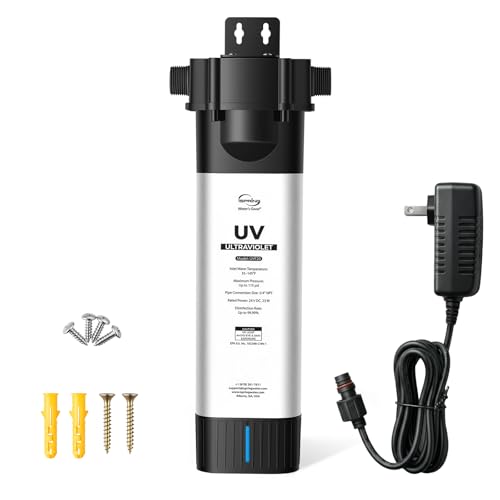
iSpring UVF20 Whole House UV System
Best for: whole house microbial disinfection
- Capacity
- 12 GPM (what this guide is about)
- Design
- Whole house
- Installation Type
- Whole house
- Features
- Automatic flow sensor
- Dimensions
- 3.3 × 5.5 × 14.2 inches
- Weight
- 3.4 pounds
View on Amazon: iSpring UVF20 Whole House UV System Affiliate link
This is an iSpring whole house ultraviolet water filter designed to treat water for your entire home. It features a mercury-free LED UV module that reduces microorganisms by up to 99.99%. The system supports flow rates up to 12 GPM and includes a built-in automatic flow sensor. It activates only when water flows, which helps extend the lifespan of the UV module. The unit measures 5.5 by 14.2 inches and weighs 3.4 pounds.
Pros
- Supports flow rates up to 12 GPM
- LED UV module lasts up to 8,000 hours
- Built-in automatic flow sensor saves energy
- Mercury-free design with no ozone or odor
Cons
- Does not remove chemical contaminants or sediment
- Requires installation downstream of a main filtration system
- Limited to 3/4-inch MNPT inlet and outlet connections
Good fit if
- You need whole house protection against bacteria and viruses
- You have a well water system requiring disinfection
- You want a chemical-free purification method
Skip if
- You need to remove heavy metals or chlorine
- You have pipes smaller than 3/4 inch
- You only need filtration for a single sink
Verdict: iSpring UVF20 Whole House UV Filter is a practical solution for homes needing broad microbial protection. It fits households with well water or those prioritizing chemical-free disinfection for the entire house.
Specifications side by side
| Spec | Waterdrop G3P800 Tankless RO System | Waterdrop G3P600 600 GPD Tankless RO | iSpring RCC7-BN 75 GPD Under Sink RO | iSpring RCC1UP-AK 7-Stage RO with UV | APEC ROES-50 5-Stage Under Sink RO | iSpring UVF20 Whole House UV System |
|---|---|---|---|---|---|---|
| Filtration Stages | 10 | 8 | 5 | 7 | 5 | not stated |
| Capacity (GPD) | 800 | 600 GPD | 75 | 100 | 50 GPD | not stated |
| Design | Tankless, under sink | Tankless | Under sink | Under sink | Under sink | Whole house |
| Pure to Drain Ratio | 3:1 | 2:1 | not stated | not stated | not stated | not stated |
| Certification | NSF 42, NSF 53, NSF 58, NSF 372 | NSF/ANSI 42, 53, 58, 372 | NSF/ANSI 58 | not stated | NSF/ANSI 372, NSF/ANSI 58 | not stated |
| Filtration Type | Reverse osmosis | Reverse osmosis | Reverse osmosis | Reverse osmosis, UV, alkaline | Reverse osmosis | not stated |
| Contaminants Removed | PFAS, fluoride, lead, chromium, iron | TDS, chromium, PFAS, radium, fluoride | not stated | not stated | Arsenic, chlorine, lead, fluoride, PFAS | not stated |
| Installation Type | Under sink | Under-sink | Under sink | Under sink | Under sink | Whole house |
| Features | Smart faucet, LED function | Smart display faucet, TDS monitor | not stated | not stated | not stated | Automatic flow sensor |
| Micron Rating | not stated | not stated | 0.0001 | 0.0001 | not stated | not stated |
| Capacity | 800 GPD | not stated | 75 GPD | 100 GPD | 50 GPD | 12 GPM |
| Use | not stated | not stated | Drinking Water | not stated | Drinking Water | not stated |
| Color | White | White | Brushed Nickel Faucet | Brushed Nickel Faucet | White | not stated |
| Dimensions | 18.1 × 5.67 × 17.7 inches | 18.1 × 5.68 × 17.8 inches | 15 × 8 × 18 inches | 15.4 × 9.06 × 18.1 inches | 15.5 × 5.25 × 17 inches | 3.3 × 5.5 × 14.2 inches |
| Weight | 33.7 pounds | 31 pounds | 27.5 pounds | 35.3 pounds | 24.9 pounds | 3.4 pounds |
| Size | 800 GPD | 600 GPD | Regular | not stated | RO System | not stated |
| Model | WD-G3P800-W | WD-G3 | RCC7-BN | RCC1UP-AK | ROES-50 | UVF20 |
Frequently asked questions
Does 800 GPD capacity mean I get 800 gallons instantly?
No. GPD stands for gallons per day. It is a daily production limit, not an instant flow rate. The Waterdrop G3P800 produces water continuously. You fill glasses quickly, but the total output caps at 800 gallons in twenty-four hours. This design supports high-demand kitchens without a storage tank.
Can a 50 GPD system handle a family of four?
It depends on your usage habits. The APEC ROES-50 offers 50 GPD capacity. It provides steady filtration for small households. Large families may find this volume insufficient for cooking and drinking needs. Check your daily water consumption before choosing this tier. It suits users who prioritize proven performance over high volume.
What does 12 GPM mean for a whole house system?
GPM stands for gallons per minute. This measures flow rate, not daily volume. The iSpring UVF20 system delivers 12 GPM. This capacity supports whole-house microbial disinfection. It ensures sufficient pressure for multiple fixtures running simultaneously. This spec is critical for homes needing broad protection without flow restrictions.
Is 600 GPD better than 800 GPD for most homes?
It depends on your household size. The Waterdrop G3P600 offers 600 GPD. It suits households needing rapid flow and space savings. The 800 GPD model provides even higher output for larger families. Both are tankless designs. Choose 600 GPD if your daily usage stays below the higher threshold.
Does higher GPD capacity require more counter space?
Not necessarily. Tankless models save space by removing storage tanks. The Waterdrop G3P800 measures 18.1 inches in length. It fits under most sinks. Higher GPD ratings do not always mean larger footprints. Design varies by brand. Check the specific width and height specs before buying.
Can I use a 75 GPD system for drinking water only?
Yes. The iSpring RCC7-BN provides 75 GPD. It is ideal for standard households. You get certified filtration for drinking and cooking. This capacity is sufficient if you do not need high-volume instant water. It fits well in typical under-sink installations where space and purity are priorities.